blueEnergy works to create a more equitable, sustainable world
Showing posts with label MIT. Show all posts

4/13/2012

Installing a biodigester in the wee hours

This has been cross-posted from MIT's CoLab Radio blog.


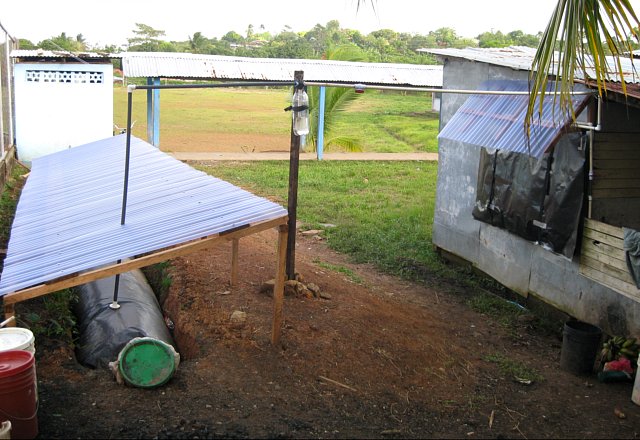
By Angela Hojnacki -- After two weeks of researching and planning several waste management strategies for the municipality of Bluefields, the “Biodigestors” team, stayed an extra week to implement a small-scale biodigester. A biodigester is machine that processes organic waste, like food and animal waste, into methane, a gas used for cooking. The ‘team’ is a subset of students from the D-Lab Waste class who studied biodigestion all semester and completed this project to earn grad credit. We built the biodigester in partnership with blueEnergy, an NGO based in Bluefields that implements wind and solar energy projects along the Caribbean coast of Nicaragua, and Colon, a local high school. ...read more at CoLab Radio

Biodigester at Colon High School in Bluefields

3/08/2012

MIT's CoLab Radio: The Life of One Wastepicker in Bluefields, Nicaragua

The following post by MIT student, Drew Pierson, about the photojournal put together by classmate, Maria Cassidy, was featured on the MIT blog, CoLab radio.  The two were at blueEnergy in January working on waste management systems for the Bluefields municipality with their classmates from a course called "D-Lab Waste." To find out more about the work done in Bluefields by the MIT students, read MIT students bring Waste Management Solutions to Bluefields, MIT builds a biodigester, and “Luz de Futuro” (“Light of the Future”) – Women Working for a Better Bluefields.

The Life of One Wastepicker in Bluefields, Nicaragua


Digital story credit: Maria Cassidy, MIT Environmental Engineering Undergraduate Class of 2014


http://vimeo.com/35638700

The following story is about Bernarda Pastora, a wastepicker in Bluefields, Nicaragua, and her experience raising children next to the dumpsite outside of town. The story was created and edited by Maria Cassidy, an MIT Environmental Engineering undergraduate student who participated in the trip through grant funding awarded to her by MIT’s Public Service Center. Maria, who also has her own environmental radio show, worked closely with the wastepickers, D-Lab Waste Instructor Libby McDonald, and project organizers to portray intimate aspects of their lives. Libby McDonald gave children living near the dump site cameras and asked them to take photos of important aspects of their lives. This digital story features the children’s photos.

This post is the third installment in a series about leveraging waste management as a means for social and economic development in Bluefields. MIT students are currently working on enterprise development projects in three areas: composting, recycling, and anaerobic digestion. This project is part of an ongoing partnership between MIT D-Lab Waste and CoLab, the City of Bluefields, United Nations Development Programme, and blueEnergy.

Ivette and Margarita
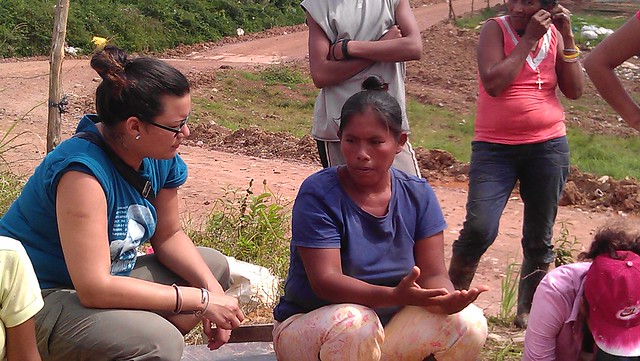
Ivette C. Luna, a student in the course, interviews a wastepicker. Photo Credit: Drew Pierson

2/24/2012

MIT works with blueEnergy to develop biofuel solution for local school

By Angela Hojnacki -- After two weeks of MIT students researching and planning several waste management strategies for the municipality of Bluefields, a subset known as the “Biodigestors” team, stayed an extra week to implement a small-scale biodigestor in partnership with blueEnergy and Colon, a local high school. This demonstration project was a nice contrast to the heavy planning work we had done the following week, and it would be a way for the community to see the concepts of biodigestion first-hand, after hearing our recommendations for the slaughterhouse the week before.

The design.


A biodigester is a simple contraption that produces methane gas from organic wastes (in most cases, manure). The idea is that the gas from this biodigester will be used to cook in the school's kitchen where they are currently using three large sacks of charcoal every day. 

As ideal as it sounded, the prospect of building a working biodigester in a community that had only seen similar projects fail seemed ridiculous, especially at 9pm, during our last night in Bluefields. Our team, plus Casey and Kenia from blueEnergy, found ourselves in the dark, outside the local high school, drenched in water and cow manure, struggling to finish the biodigester we had started to build only five days earlier. With all of us at the end of our ropes, we contemplated how it was possible to ensure the sustainability of the project.

We began this “mini” project on Saturday, after seeing the rest of the DLab Waste team head back to Boston. Armed with whatever shovels and gardening tools we could find, we began to dig the trench With the help of George Bloomburg, an English teacher at the high school, and Vicente, the security guard, we had managed to remove two trees, clear the grass, measure out the trench, and break the ground by the end of the first day. After a few days of hard work in the sun, we realized how much work we still had to do (and how much more there was to learn about digging in Bluefields’ very clayey soil).

Smoothing the walls of the trench

The biodigester we built was a ten-meter long bag biodigester, which consists of two layers of a polyethelene plastic. The system consists of the bag (which is filled with water to seal the waste inlet and outlet), a gas outlet, a pressure release valve, a reservoir bag, and a typical propane stove that is adapted to use biogas. After finishing the trench, we laid the bag inside and began assembling the plumbing that will transfer the gas to the kitchen. Following the instructions used to build biodigesters by other DLab courses, we attempted to inflate the bag with car exhaust to expel any oxygen. To then seal the bag, we filled it with water; however, our only water source was a nearby well, and our daylight was fading quickly. Passing buckets of water in an assembly line, this is where we found ourselves the last night of the project.

After discussions that lasted most of the night, Alex and I decided to stay an extra day, and with that time, we were able to leave the biodigester and Bluefields knowing that it was in good hands with blueEnergy. Alex and I added the rest of the water needed to seal the biodigester, finished assembling the stove - with the help of Casey and the shop workers - and cleaned up the kitchen area at the school. Since our departure, we have kept in contact with blueEnergy, and our bag of poop is doing splendidly so far. While many biodigesters like these fail, we can only hope that our partnerships, regular communication and maintenance will ensure the success of this project, and hopefully the biogas production and utility will continue to convince others that this technology works.

Biodigester producing gas

2/08/2012

“Luz de Futuro” (“Light of the Future”) – Women Working for a Better Bluefields

By Angela Cacciola - “I’d like to formally introduce Margarita – President, Luz de Futuro,” proudly announces Ivette Luna, Policy Development and Political Organizer for Neighbor to Neighbor in Massachusetts, USA. Ivette accompanied a group of MIT students during their two-week trip in January to work on waste management with blueEnergy and the Bluefields municipality. Margarita strides to the front of the crowded auditorium at INATEC school in Bluefields, Nicaragua. Her body language acknowledges no personal insecurities or any potential difference in status between herself, a waste picker at the Bluefields dump, and the students from MIT, blueEnergy international volunteers and local staff, or various workers from the Bluefields municipality and other NGOs.

Margarita (R) tells the story of her mother,
"Luz," for whom the new cooperative is named.  

Margarita begins strongly, and after introducing the rest of the women who comprise the new organization’s board, she explains the significance of Luz. “The name ‘light’ comes from a colleague of ours who worked many years as a waste picker. She liked to work very much, and she got ahead. This woman, she was my mother. She encouraged me to become a waste picker. Now, I pick up everything I can to resell it. Thanks to this work, I have been able to get ahead too. I’ve been able to have my own house and my children… they study at school. One of my boys is in his first year, and the other is in his second year of high school.” She grins and takes her seat.

Ivette continues, “After observing how hard these women work each day, their vision ‘women working for a better future’ couldn’t be more perfect.” She highlights some of the other values of the organization, which include self-reliance, shared work and profits, better working conditions for working mothers (which they all are), and work training. Her presentation concludes with a synopsis of the students’ hopes for the municipality to enter in a contract with Luz de Futuro for the next five years. Through such an agreement, the municipality would provide the space and equipment (conveyor belt, compactor), materials (recyclables collected from homes), and delivery of recyclables to recycling center where Luz de Futuro would be housed. 
Families working together

For two weeks in January, the MIT students got to know Margarita and 26 other women who work at the garbage dump in Bluefields. Their work was kicked off by a meeting set up by blueEnergy with Gerardo Bravo, director of the Department of Environment for the municipality of Bluefields. Gerardo stressed the passion of the women waste pickers, who had already started to organize themselves, and who needed to continue doing so for job security. “One morning, there were at least fifteen women waiting for me when I arrived at work, all dressed very well. I thought that maybe I had forgotten about a meeting I had scheduled, and was embarrassed by my own casual clothes. But in fact, there was no meeting scheduled in my day. These women came to me because they wanted to make sure that with the development of the new dump in Bluefields, they would still have access to the garbage they earn a living on.” 


After meeting with the women many times at the dumpsite and bringing them to the blueEnergy house where they worked from, the MIT students harnessed their passion to help them formally establish “Luz de Futuro” at the municipal government offices in Bluefields. As an official cooperative, the women now have much greater bargaining power in the public arena. In terms of economic development, they are the first step in the three municipality recycling route MIT professor, Libby McDonald, is working to create with UNDP, blueEnergy, and her students. Recognizing the combined efforts of the MIT students and the local women, Gerardo Bravo stated at the end of the presentation, “It is impossible to just work [in Bluefields] on one problem in isolation. We also have to think about working together. … Today we’re seeing coordination so that our efforts can bear fruitful to this idea of a solid waste management system. I’d like to thank you all in the name of our mayor. I see you as a predominant force in this community that ensures we are going to get closer and closer to our goals.” 
Waste pickers at the Bluefields dump
For a closer look at the extraordinary conditions the women of Luz de Future currently work under, see the short video, Snapshot of Life in a Nicaraguan Dump Site, by Libby McDonald and Daniel Alegría. Or, for more information on the work being done by Professor Libby McDonald and her students in Nicaragua, visit the blog they are continuing to update Waste Management Strategies in Coastal Nicaragua.
Women of "Luz de Futuro" sitting in front of blueEnergy
cofounders and directors, Mathias and Guillaume Craig.

1/27/2012

MIT students bring Waste Management Solutions to Bluefields

By Angela Cacciola - Right now, they don’t move any plastic out of Bluefields… or very little. Instead of localizing their garbage, people often toss empty packets of chips or cookies, bags used in commercial exchanges, soda and juice bottles and other miscellaneous items in the streets. Mud-smeared trash, piled up everywhere and stinking, does not compliment the wild array of colored houses that could potentially attract tourists, or more importantly, help create sanitary conditions in a town where trash and sewage saturate the same ground that supplies drinking water.

To address this issue, dressed in homemade newspaper skirts and hats littered with trash, students from MIT enthusiastically introduced the idea of sorting household garbage to a curious crowd at the main park in Bluefields. The event of song, dance, and candy kicked off what they hope continues to be a community campaign promoting their projects that will allow Bluefields to begin to approach zero waste.

MIT composting team talks with the composteras
For the fifteen students, these projects are the culmination of a fall semester class, D-Lab waste, which offers them the opportunity to explore and create solutions for waste management in low and middle-income countries. For their professor, Libby McDonald, the two weeks spent in Nicaragua with her students is part of a project with the UNDP, Bluefields municipality and blueEnergy, which began almost a year and a half ago.

While this culturally diverse group hails from all ages and professions, all arrived in Bluefields with three common goals: to create an independent worker cooperative with the local waste pickers, to plan for the expansion of the existing compost program and to design a biodiogester that creates methane and fertilizer from waste at the slaughterhouse. The students worked all semester but for many of the urban planners in the class, the Bluefields experience was, “boot camp for international development.” However, Libby emphasized, “the really important moment is when the student can go from the bottom, being despondent and feeling like they have nothing to give, to realizing that indeed, they have worked hard to understand the situation and have recommendations that are worth sharing.”

Alex connecting pipe on a biodigester
“Originally, I felt nervous going into peoples’ houses and neighborhoods,” said MIT student Alex Marks. “I expected a certain level of distain, one based in bitterness caused by contrasting economic means.”  Soon he realized that, “there’s no plumbing here, no hot water, but people still live happy and healthy…and they don’t hate me.” Furthermore, after his experience in Bluefields, Alex, who initially said he had no background in development and, “no inkling towards it either” wants to continue in the development sector, "where you can really have a contribution to growth."

In the end, the group was able to do just that… have a contribution to the growth of Bluefields and its waste management system. Through meetings coordinated by blueEnergy with locals ranging in profession from garbage pickers to the city mayor, the students were able to understand the dilemmas posed by working in a marginalized community. After two weeks, they gave a public presentation on the problems they identified in the municipality and their recommendations for improvement. Furthermore, on February 1st, each of the three groups will present a formal report on these finding to the municipality. To learn more extensively about their experience and recommendations, please visit the CO-Lab Radio blog which is still being updated, Waste Management Strategies in Coastal Nicaragua.

Over the next two years, blueEnergy looks forward to a continued collaboration with MIT and Professor Libby McDonald, who plans on bringing more students down to continue building the projects and hopefully creating the beautiful city Bluefields has the potential to be.

9/26/2011

blueEnergy: The Ultimate Fieldwork Preparation for a Career in Development


By Ben Hyman -- This month I moved to Mumbai, India, to work as a research associate on a project that aims to implement and evaluate the country’s first emissions trading scheme—also known to many as a “cap and trade” program for particulate matter (pollution). As I explore the customs of this new country, the challenges of working closely with the Indian government, and the institutional processes that facilitate getting work done here, I can’t help but feel that this experience is eerily familiar—one that blueEnergy has trained me for.

My year and a half working with bE has a lot to do with how I came to both this exciting job opportunity in India, and a relative state of calm in the face of challenging new development projects. At the beginning of 2008, I joined bE as a wide-eyed volunteer, fresh out of undergrad, ready to get my hands dirty with infrastructure development in Latin America. During my first few months in rural Nicaragua, I learned a key lesson popular among bE field workers: hurry up and wait. While this unofficial motto was half an observation of how we were doing business and half a coping mechanism for sometimes frustrating aspects of the project, it also said something deeper about the importance of patience and adaptability. In Nicaragua, I came to understand the craft and diplomacy that goes into getting business done in a place like Bluefields—a skill that I find myself using every day as I forge new relationships and address new deliverables in India. Just like in Nicaragua, projects here don’t happen overnight, and you can’t expect to mold a long-standing system of processes to your own vision of efficiency.

But perhaps an even more substantive role that blueEnergy played in my path, has to do with the fact that I first explored impact evaluation in a serious way while at bE. After having focused on communications and community relations, I wanted to become more involved in understanding the trade-offs between different rural electrification strategies, and bE saw value in the change of focus. Getting my first taste of data management and survey design, I would eventually quench my thirst for research and enroll in graduate studies at MIT, which ultimately led to my current job placement.

Today, when I face questions like “how do you measure a household’s income when the household head does not know how much they make or only trade goods for goods? “ or “this government agency is not responding to any of my calls to implement further projects, how do I expedite the process?” I am grateful to have had my time with blueEnergy which permitted both self-exploration and the development of key skills and tools that are central to development projects and policy around the world.

Bonboy, a blueEnergy system operator in Monkey point, and Ben Hyman


9/19/2011

MIT video: Waste pickers from Bluefields

From MIT comes a video on life at the Bluefields dump. It's a real eye-opener for people who haven't experienced a visit yet.


Waste pickers, Bluefields, Nicaragua 2011 from Erik Flakoll Alegría on Vimeo.

http://colabradio.mit.edu/snapshot-of-life-in-a-nicaraguan-dump-site/

By Casey Callais -- The MIT Community Innovators Lab partners with D-Lab on a fall course where students collaborate with wastepickers, the UNDP, blueEnergy, and the municipality of Bluefields to develop waste management strategies that reduce greenhouse gas emissions and create enterprise opportunties for the women featured in this film.