blueEnergy works to create a more equitable, sustainable world
Showing posts with label latrines. Show all posts

10/06/2012

From Berkeley to Bluefields and Back: Cal Energy Corps Student Symposium

By Kate Graham --blueEnergy is known for going to the edge, working where others won’t to provide energy access, clean water and sanitation solutions to those living along the Caribbean coast of Nicaragua. But, who are these individuals choosing to cross borders and spend their time working on the periphery, navigating an area lacking roads, modern equipment, tools, and power? Many are participants in blueEnergy’s Global Leadership Program, a program geared to provide the next generation with the opportunity to witness and respond to the needs of the most isolated poor.
bE co-founder Mathias Craig speaking at the symposium

This past summer three Cal Energy Corp students, Casey Finnerty, Mauricio Castillo and Jonathan Lee traveled to Nicaragua to participate in blueEnergy’s Global Leadership Program. The Cal Energy Corps is an undergraduate internship program created to engage the best and brightest students from UC Berkeley in the design, development, and delivery of sustainable energy and climate solutions across the world. Through Cal Energy Corps student research efforts, blueEnergy is able to test and pilot new solutions that have the potential to become services providing great value to blueEnergy’s beneficiaries.

Superstars! Casey, Mauricio, Jonathan

Casey, Mauricio, and Jonathan spent 9 weeks with blueEnergy (details from their time in the field is documented here and here) and arriving back at Berkeley were given the opportunity to present projects and blueEnergy experiences at the Cal Energy Corps Symposium. As they stood beside posters highlighting their work, each student spoke about the challenges associated with project implementation in rural coastal communities and the best practices that emerged after weeks of researching and testing.
Well rounded audience

The Symposium continued with a welcome by Dr. Graham Fleming, Berkeley’s Vice Chancellor for Research. Dr. Fleming mentioned blueEnergy as a key Cal Energy Corps partner committed to providing meaningful experiences for students. Dr. Arun Majumdar, former professor of materials science and engineering at Berkeley and expert in transformational energy research and development, spoke to the audience in a key-note address about sustainable energy access as a human rights issue and encouraged Cal Energy Corps students to continue a path focused on global solutions.
Jonathan Lee: “Improving Longevity of Small Off- Grid Solar Photovoltaic Installations"

The symposium ended with a panel discussion, which included Mathias Craig, blueEnergy Founder and Executive Director. Mathias mentioned his summer visit to Nicaragua, where he witnessed Casey, Mauricio, and Jonathan working on the beginning stages of their projects – identifying beneficiaries, creating schematics, strategizing with blueEnergy technicians. Mathias also noted how well the students integrated into the culture and community of Bluefields. He praised Cal Energy Corps and called on Dr. Fleming to “send more students to Bluefields.”
"Send more students to Bluefields!"

blueEnergy is thankful for the ongoing relationship with Cal Energy Corps and appreciates following and supporting the progression and growth in projects and students from Berkeley to Bluefields and back. blueEnergy believes that through facilitating opportunities at the edge, in places far off the radar, stronger, more capable leaders, like Casey, Mauricio, and Jonathan will emerge, with the capacity and drive to create a more equitable, sustainable world.
(L to R) Tiff Dressen (New Initiatives Manger: Vice Chancellor for Research),
Casey Finnerty, Mauricio Castillo, Jonathan Lee, Mathias Craig, Kate Graham

For more information about blueEnergy’s Global Leadership Program and opportunities to work with blueEnergy in Bluefields, Nicaragua, please e-mail US Development Officer, Kate Graham at: kate.graham@blueenergygroup.org.

Check out our Picasa album for more photos!

7/22/2012

Infographic: Poop in the developing world

Cool infographic on the state of the poop in the developing world. This really helps to put blueEnergy's work with clean water and sanitation into perspective...it's just a drop in the bucket (so to speak), but every little bit counts!


Lack of Sanitation
Created by: OnlineNursingPrograms.com Special thanks to Tony Shin.

1/10/2012

bE hosts ¨Exchange Forum of Technologies and Methodologies: Solar Latrines¨

By Angela Cacciola - When you make a commitment to work in a geographically isolated, former war-zone, where heat, humidity, salinity and hurricanes wreck havoc on obtaining and maintaining resources, logistics are quite complicated.As these problems compound with various social issues, including low-level economic activity, inadequate formal education levels, parallel governments, and multi-ethnic and multi-lingual groups, a holistic approach to the development of marginalized societies becomes required.

As blueEnergy Nicaragua Country Director Guillaume Craig states, Bluefields “is not the ideal place to re-invent the wheel.”Instead, it’s the place to learn how the wheel was made, find the sturdiest, cheapest, most available tools to build a modified wheel, and then find locals who can carry out the technical work.Accordingly, while blueEnergy invests in research and development, a key strategy in its overall plan includes catalyzing national networks and “bringing them together to work on the common goal of community strengthening through… interchanges.” Collaborating technologies and strategies with partners and beneficiaries is vital to blueEnergy’s organizational success.

Angel Rivas explains double pit, waterseal,
composting latrines to conference attendees.
In the first week of December, blueEnergy organized and hosted the Exchange Forum of Technologies and Methodologies: Solar Latrines.The two-day conference brought together a variety of local development partners, including FADCANIC and FUNCOS (NGOs), INATEC (technical school), and BICU (university), along with a representative from the Bluefield’s mayor’s office. Special guest, Angel Rivas, came from El Porvenir, an NGO based in the United States that works on the Pacific side of Nicaragua.

Over the past 20 years, El Porvenir has completed 740 projects in water, sanitation, reforestation and education.It currently provides 105,000 people with drinking water, and has planted 530,425 trees and built more than 888 improved stoves. In 2009 alone, El Porvenir helped villagers build 584 latrines, 9 washing stations, 26 wells, 2 gravity flow systems, and 151 low-fuel stoves.

During the morning of the first day, Mr. Rivas presented El Porvenir’s style of double pit, water seal composting latrines. These latrines have been well received by their beneficiaries and many of the first latrines installed are still in use today. Mr. Rivas noted the pros and cons of each latrine design, along with their technical standards, material designs, and costs. He also addressed the equally important social concerns of implementing the projects with regards to monetary contributions, labor, and community involvement.
FUNCOS liason discusses the composting process used by the farm.

On the second day, conference attendees visited FUNCOS, which provided technical information on water, sanitation and improved cook stoves. Attendees also visited blueEnergy solar latrines, composting toilets, bio-arena water filters, and Baptist wells. The event culminated in presentations by local partners on additional cook stove technologies and a large group discussion on the potential for implementation on the Atlantic coast for the various technologies presented.

From this knowledge-exchange workshop, Angel Rivas says he is “most interested in the solar latrine,” which he thinks “could be a viable technology for use in the rural mountain areas where El Porvenir works.”blueEnergy will be using the information learned during the conference to identify the best model for future community development projects.Overall, as blueEnergy Nicaragua Country Director Guillaume Craig notes, the gathering was a “very productive and enriching experience,” and yet another progressive step in blueEnergy’s continuous work “for a more equitable, sustainable world.”

L-R, Vladimir (bE), Angel Rivas (El Porvenir), Thibaut Demaegdt (bE), Guillaume Craig (bE) and Jorge Ramos (bE)

8/09/2011

blueEnergy Experiments with its First Solar Latrine

By Andrew Peterson and Mark Allison -- As the world population approaches eight billion people, basic sanitation and waste management will become an increasingly difficult and important topic. Mismanagement of waste can contaminate potable water sources, spread disease and contribute to diarrhea, the second leading killer in developing countries. To address this issue in the Bluefields community, blueEnergy gave Service Learning (SLI) interns, Mark Allison and Andrew Peterson, the task of implementing  solar latrines into the water and sanitation department of blueEnergy. Overall the goal is that solar latrines will help offer a sustainable and sanitary solution to waste management in Bluefields.

Many latrines in the Bluefields community are basic pits dug into the ground and have the possibility of contaminating gound water sources, affecting the families that use them. This was the case with the family that was selected to be the first beneficiaries for a blueEnergy solar latrine. The family was selected due to their location (solar radiation, a garden, no close ground water source, and available space for construction), their interest in the solar latrine project and the need for a more sanitary waste management system. The latrine that the beneficiaries were using before blueEnergy’s project was a rustic latrine that had one pit for garbage, solid, and liquid waste. The rustic latrine also did not have adequate walls for privacy or ventilation for bugs and smell.
fig 1. Solar Latrine Beneficiaries
fig 2. Rustic Latrine previously used by the Beneficiaries

As mentioned before, solar latrines are sustainable and sanitary. Using a solar collection chamber (fig. 3) human waste is cooked and dried, effectively killing any harmful bacteria and leaving rich compost that can be used to improve crop yields. The chamber is divided into three sections into which waste is raked every 15 days. To make sure that the human waste dries completely, the solar latrine has a toilet bowl that contains two different bowls (fig. 4). Solid waste goes into the larger back chamber, while liquid waste goes into the front bowl and then into a separate pit outside the latrine (fig. 5).

fig 3. Solar collection chamber

fig. 4 Toilet seat with divisions
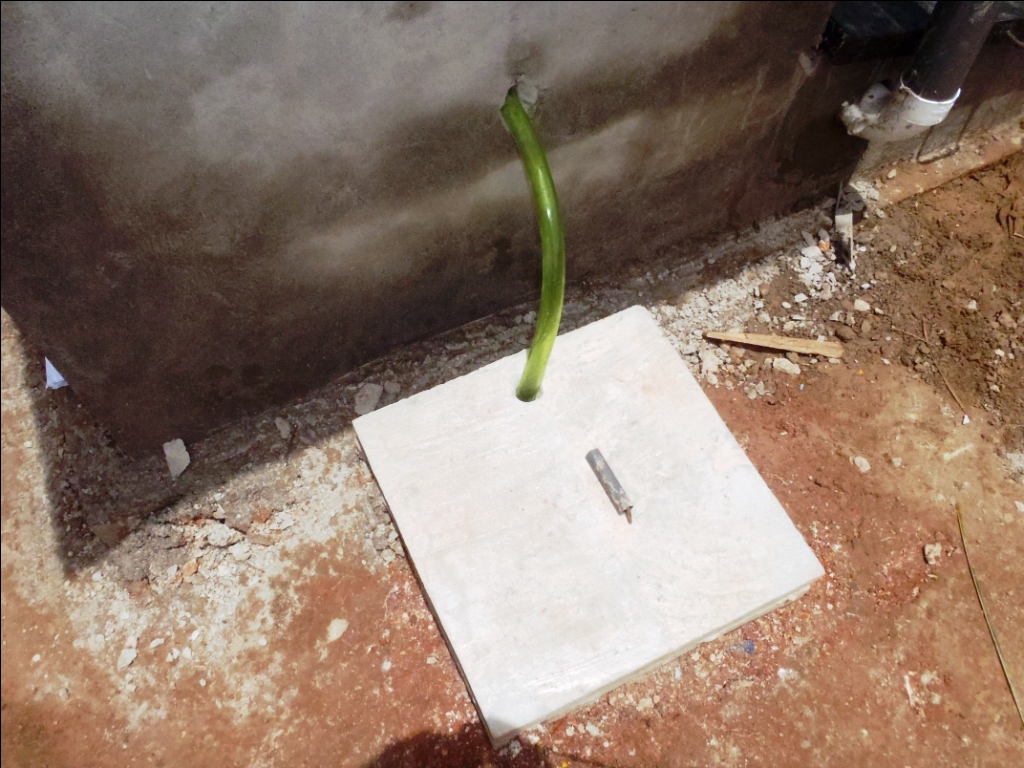
fig. 5 Urine filtration chamber


In the following weeks blueEnergy will be performing follow up evaluations and further education with the beneficiaries. As part of the contract that was signed, blueEnergy will be permitted to make regular visits to the site to take temperature readings of the chamber, evaluate the compost and make sure that the beneficiaries are using the latrine correctly. Depending on the outcome of these visits blueEnergy will be able to determine if solar latrines are successful in Bluefields or if a different type of latrine should be built and tested by future SLI’s.

Mark and Andrew and future latrine builder