blueEnergy works to create a more equitable, sustainable world
Showing posts with label install. Show all posts

11/29/2011

The Gift of Light: Rocky Point, Nicaragua


By Angela Cacciola -- “I didn’t ask for it! But by God, am I thankful. We got light!” exclaims Miss Suzanny after her solar panel installation. Our two days in Rocky Point are filled with emphatic expressions like these. Earlier, Miss Suzanny’s son-in-law, Gene, joked, “To hell with Chonky and his light, I got my own!”

Forty families live in Rocky Point, a small farming community located between two larger coastal towns in the Southern Atlantic Autonomous Region of Nicaragua. Although the power lines pass through these lands, there are no plans to connect the houses here to the grid. Up until blueEnergy arrived in late November, candles and kerosene lamps produced the only light found in the little wooden homes at night. This has proven to be a dangerous solution to lighting needs. Last year two children died in a house fire in a neighboring community caused by a candle burning in their room. Now, two homes in Rocky Point are graced with 30-watt solar panels which provide four hours of light daily. Starting next year, blueEnergy hopes to continue its joint efforts working with the local governments and the local Peace Corps volunteer to provide solar panel systems to rest of the families who need light.

Installing Solar Panels in Rocky Point


Each solar panel system installation takes between four to six hours, and everyone around contributes to the efforts. The women cook delicious local specialties, the men chop down the posts necessary to raise the solar panels above the house and help with the electrical installation and the children retrieve whatever tools the men require.

Our first beneficiary, Chonky, greets us enthusiastically from his porch. Today his grandchildren are not around, but he does not remain alone for long. Soon enough, five friends arrive to help with the installation. Hours of laughing and good-natured joking, usually concerning the universally masculine topics of women, wine, and song, follow our brief, informal introductions.

Chonky's house is even dark in the daytime

Chonky is thrilled to finally be able to cook and read at night after work. “I read my bible,” he says. “I read these (pointing to magazines) what have notes of what going on in the world.” He holds up a half dozen spiral-bound manuals, “I am a technic man…I have a lot of course that I take and reference back to the material.” At night, Chonky’s lights can be seen shining from the hammocks close to his house where we sleep. On, off. On, off. A fundamental service like electric light can serve to amaze those who acquire it for the first time.

Panel at Chonky's house
Shortly after dawn, Gene leads us to his mother-in-law’s house for the second installation. The approach to Ms. Suzanny’s house is a picture perfect walk though a coconut grove flanked by enormous piles of coconut husks. Orange and cacao trees, sugarcane, corn, yucca, and beans, scattered throughout the grove provide ample amounts of food for people and animals alike. In the back sits a dilapidated, three-room, wooden house, complete with a hammock swinging from the front porch. The abundant coconut husks do not only remain in the forest; many are pressed into the dirt around the house, sufficing as a walkway to endure the sodden, muddy earth. Pigs relish in these mucky conditions, and can be seen competing with the chickens for scraps. If you stick around long enough, horses and cows will come by, and you might be able to catch a glimpse of the skittish calf left orphaned by disease.

The second install takes place with relative ease, as the panel fixed on the top of the wooden post chopped down from the bush is tied into the charge controller and battery. Gene’s two young sons take a shy interest and soon warm up to us. They make great helpers, responding quickly to find tools or help hold materials. We explain the difference between positive and negative, how a battery works, AC vs. DC and what the lights on the charge controller mean. Gene is just as fascinated as the boys, and repeats our explanations in his own words. He wants to be the first person the community calls on if there is any technical trouble.

Gene and Casey from blueEnergy running wire


Rocky Point the Community

Throughout the day, the family imparts their own knowledge upon us as well. Gene shows us how to properly use a long stick to shake coconuts from the tops of the trees and open them with the machete. His boys demonstrate the best way to forge through the jungle, swinging low with each slice of the machete to kill any potentially lethal snakes before stepping on them. They also boast their skills with slingshots, quickly returning with a bird. Miss Suzanny offers her kitchen expertise, the manner which to grate coconut and make tea from “cowfoot” leaves, along with hours of local history. 

Gene's kids help Casey secure the solar panel

During her mouthwatering lunch, Miss Suzanny takes out a poster board covered in pictures of the community’s progress over the past year. She talks about the communal house that was built and the weekly educational sessions that are to the adults who never had an opportunity to get much education. Clearly this farming community lives much more intimately than those in many places who have access to instantaneous communication resources. “If we see someone needs help, we will be right there doing whatever we can,” Miss Suzanny affirms. “We work together here. If he needs ten pounds of corn to plant this season and I have it, I will give it to him. Next time I need something, he will give it to me too.”

Ms. Suzanny and Gene with Gene's kids

The people of Rocky Point do not have much, but they share with us all that they can. We bring them their future, and they remind us of our past. The 30-watt solar panel blueEnergy installs in each house cannot power a factory, but it is enough to power two 9-watt bulbs. Two light bulbs are enough to give Chonky a few more hours a night to study his continuing education manuals and Gene’s kids time to finish their homework before they go to bed. Two light bulbs are enough to give both families peace of mind, instead of worrying about an open candle flame burning inside their homes. For the first two families who received light in Rocky Point, two light bulbs are a blessing.

It is because of stories like the one above that blueEnergy remains committed to providing basic energy services to people in some of the hardest to serve regions in the Western Hemisphere.

We ask for your support to help us help many more Chonky’s and Ms. Suzanny’s. Every amount counts as our network of support grows and we find strength in numbers.


Join us to make sure that everyone gets a chance. Give the gift of light.

3/05/2011

blueEnergy adds refrigeration capacity in Monkey Point

By Caroline Dehais - blueEnergy recently made a trip to Monkey Point for two key installations: the second communal freezer donated by HIVOS and the special refrigerator for vaccines donated by Renewable World. Both of the systems are powered by autonomous solar arrays with batteries donated by Trojan.

Fridge for the Health Clinic
 
Fridge for the health clinic in Monkey Point
The blueEnergy team departed Bluefields the morning of the 21st and thankfully the sea was quiet! The team was composed of Cindy from the social team, Ronald, Guthry, Vincent and Caroline from the technical team, and Franklin Sanchez from the MINSA, the national ministry of health.

The first task was the installation of the health center’s refrigerator, which meant attaching the solar panel to the old and corroded roof, passing the cables inside the roof, making the connections to the control panel and batteries and making all the electrical connections for the lights of the health center. The next morning we turned on the fridge and by the afternoon the temperature had dropped to the required temperature for vaccine storage.

 “When they came in December asking me if a freezer for the health center would be useful, I said yes,” Carla, the charge nurse, said. “But I thought it would never come because nothing comes to my health center. And then two weeks ago they tell me the fridge would be installed soon, I thought I was dreaming, I’m so happy to have that vaccine fridge for my community!”

Freezer for the community

Carla's house with panels installed in front
The freezer donated by HiVOS is the second installed in Monkey Point. After studying how the first freezer, a common model found in department stores, performed over nearly a year, it was decided the second freezer should be an ultra-high efficiency DC model. The system has two 135w solar panels charging four 12v 105ah Trojan maintenance-free batteries, allowing for five days autonomous use. 

The freezer now belongs to the energy commission and is being rented to Carla for about $1/day (energy commission proceeds go to maintenance of the electrical systems). Carla had submitted a business plan to blueEnergy which consisted of using the freezer to sell meat, fish and other goods. It is now located in her house which is very close to the communal house and easily accessible. 

Return to Bluefields proves difficult 

The return on Thursday afternoon was a complete adventure, although it began without any trouble. The sea was not particularly rough, but the waves became much more turbulent as we arrived at the critical point called la barra where the sea meets they bay. The tide heading out from the bay meets the swells coming in from the sea, creating big chop.

Allen steering the panga being towed in the bay
As we entered the bullseye of la barra and the waves became worrisome, the motor lost power and died. Without any forward direction, it didn't take long for the waves to turn the panga broadside and begin to break in the boat. The passengers quickly sprang into action to empty the panga anyway we could using water jugs, pots and even flip-flops. Guthry, one of the bE staff, was in the bow with the paddle trying to keep the panga facing the oncoming waves as Allen, the panga driver, struggled to start the motor. It seemed we had miscalculated the amount of gas needed; the tanks were nearly empty. Allen consolidated every drop we had which was enough to start the motor, and we made it to the calm safety of the bay.

 It was not enough to make it home, however, and about 1 km before arriving to Bluefields’s wharf, the gas was finished and we were left stranded once again. Luckily we hitched a tow to the shore from a little dory with a 2hp engine where Casey met us with a gallon of gas.

12/10/2010

Baptist well drilling pilot project wraps up

By Thibaut Demaegdt -- Back in August, blueEnergy received a kind visit from Paul Cloesen, a Belgian expert in Baptist well drilling, who trained blueEnergy water technicians on this appropriate technology. Paul had previously drilled more than 200 wells in several regions of Nicaragua, but he had never come to the Caribbean coast and the technology had not reached Bluefields.

Paul stayed for a week in Bluefields, during which he helped blueEnergy build the drilling tools and dig the first well. He trained us on all the aspects of well drilling, so that when he left, we felt confident that we could continue drilling wells on our own. Indeed, after Paul left, four additional wells were drilled and have proven to work well.
Well beneficiary digging while Vince and Paul discuss 

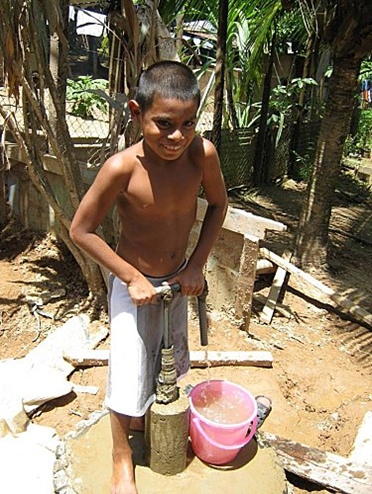
A Baptist well consists of a 2” PVC casing with a home-made PVC hand pump. All the materials are locally available and the drilling tools were built in blueEnergy’s workshop. A 60-foot deep well costs approximately $50 in materials, plus the workforce of a 10-person team during a week. The beneficiaries are highly involved in the drilling process and are also trained on how to build their own pump. In case something breaks, they are, therefore, able to fix or replace it, which will make the wells sustainable.

Baptist wells are deeper than regular hand-dug wells, which makes it possible to pump water from less contaminated layers. Samples will be analyzed by the Health Department to confirm that the water quality of Baptist wells is better compared to regular wells. In a city such as Bluefields where the soils are heavily polluted, this could have important sanitary repercussions.
Pumping water from a finished well
This pilot project has been a bigger success than expected: many people in Bluefields have heard of the wells and want one. So far, blueEnergy has not figured out the best way to meet the demand and spread this technology...carry out the whole drilling process, train people to drill their own well, perhaps?

A project for 30 wells in Bluefields funded by French institutions has recently been approved and will start in early 2011. Baptist wells are also a suitable technology for remote communities where the density of population is low and traditional wells are too costly to be considerate as a viable alternative. 

1.2kW solar install in Tiktik Kaanu

By Casey Callais -- It was a long and challenging five days. We arrived after a sun-scorched ride up a jungle river, worked under constant threat of tarantulas, scorpions and a snake locally known as a mata vaca (cowkiller), and shared our rooms with bats and cockroaches that could carry off anyone who dared step on them (well, that part is an exaggeration, but trust me when I say they were BIG). The setting: Tiktik Kaanu, a Rama indian village on the Kukra River, deep in the Nicaraguan jungle. We had set out for the CETAF agro-forestry campus of the Bluefields Indian and Caribbean University. The challenge: we had less than a week to install a 1.2kW solar panel system to provide renewable energy to the caretakers' home and CETAF meeting hall. There are no phones, no electricity, no running water and no Home Depot around the corner if we needed extra screws. And of course, no hospital if the mata vaca decided to try his luck on we humans.

Control panel, battery bank and the donors that made it happen
We humans were six. Ronald ran the show. He is from Bluefields, Nicaragua and is the Director of Operations for blueEnergy. Alex is from Tiktik and has been working with blueEnergy for over a year. Vince is from France and is the coordinator for the productive uses of blueEnergy. If it is powered by our installations, he is in charge of it. Guillaume is a blueEnergy intern whose arrival was timed to give his engineering expertise. Then there was Simon who captured the installation on video and, of course, there was me. I was in charge of trip logistics and the house wiring. We were a team of blueEnergy veterans mixed with bE newbies in a community only one of us had been to. But we quickly found that we all were happy to brave the jungle creepy crawlies and put in the hard hours to get the job done.

Day one one team determined the optimal panel position while the second team began wiring the meeting hall. Day two was spent setting the foundations for the solar array and work began on the control panel. The solar panels were put in an day three, and the remaining days were spent running wires, cutting conduit, installing fixtures and working on the control panel. Needless to say, the days were long and sometimes frustrating. On day four I was thinking how nice it would be to have that Home Depot around the corner for more screws, but we made due with what we had. Before the caretakers had finished preparing lunch, we would run to the river for a quick swim. After lunch, it was back to wiring lights and running conduit, or positioning the control panel and installing breakers.  

On the last day as we were finishing up, representatives from the university arrived to inspect their new system. We had installed enough solar capacity and batteries to keep the ten rooms and the auditorium lit up throughout the night. We had given the students the opportunity to do their work later than sunset. The university was thrilled and the caretakers ecstatic. We were exhausted but very happy with the results.

Solar panels with the meeting hall/dorm behind


Check out the video in Spanish/English with French subtitles!

9/10/2010

Installing a water filter in the FADCANIC school in Pearl Lagoon


blueEnergy installs a biosand water filter at the FADCANIC school in Pearl Lagoon.