blueEnergy works to create a more equitable, sustainable world
Showing posts with label Renewable World. Show all posts

12/05/2012

Rama Cay Health Center Receives Solar-Powered Water Filtration System

By Casey Callais -- The drinking water in the tiny island of Rama Cay is dirty. Very dirty. And not in the sense that it can be cleaned by simply scooping out pollutants with a sieve. Much of what contaminates open well drinking water can not be seen by the naked eye; fecal coliforms cannot be scooped out. Neither can protozoa or the many other contaminates, which populate the 5 wells that the 1,000 residents of Rama Cay use for washing, bathing and drinking. Diarrhea is a serious problem (you can hear Maria, the nurse in Rama Cay explain why here) and the population most vulnerable to such contamination rely heavily on the well at the Rama Cay health clinic.

To tackle this problem, blueEnergy engineers devised a clever solution that weds the organization's experience with solar power and biosand water filtration to create, you guessed it, a solar-powered biosand water filter!

With funding from Renewable World, blueEnergy designed and installed a system that pumps water from the clinic's well to a holding tank that then drips into a biosand filter and from there into a holding tank. The system is controlled by a series of float valves that allow water to pass until the tank is full.

Here is an example of the system:


1. The solar panel on the roof of the health clinic powers the electric pump in the well.

2. The submersible pump is controlled by a float switch in the top tank. When the float is down and the sun is out, the pump sends well water into the top tank until the float comes up and cuts the pump off. 

3. There is enough well water in the top tank for several days of the clinic's water requirements. Gravity draws water from the top tank to the filter.

4. Water drips into into the biosand filter at a slow rate giving the good bacteria a consistent supply of bad bacteria to munch on. The water filters down through the barrel of sand and into the clean water storage tank.

5. Clean water is stored in the lower tank which is still high enough to supply water pressure to the clinic.

6. Patients in the health clinic can drink clean water and the staff can work in more sanitary conditions.

No longer is there worry at the health clinic over contaminated water and the sickness that it brings. This installation provides the solution and represents the strong bond between the indigenous community of Rama Cay, blueEnergy and Renewable World.


9/28/2012

Nobel Laureate, Dr. Dan Kammen visits blueEnergy

By Casey Callais -- For Dr. Dan Kammen, trekking through isolated regions of Nicaragua on horseback to visit renewable energy systems at an agro-forestry reserve is all part of the job. 

Dr. Kammen is Professor in the Energy and Resources Group Energy and Resources Group (ERG), Professor of Public Policy in the Goldman School of Public Policy and is Professor of Nuclear Engineering in the Department of Nuclear Engineering at the University of California, Berkeley. He is also the founding Director of the Renewable and Appropriate Energy Laboratory (RAEL). Dr. Kammen advises the US and Swedish Agencies for International Development, the World Bank, and the Presidents Committee on Science and Technology (PCAST).

Long time supporter of blueEnergy, Dr. Kammen visited the Caribbean coast of Nicaragua in August to see blueEnergy's work firsthand and to hold a presentation about climate change. Dr. Kammen arrived as a special guest of the US Embassy in Nicaragua.

The following photo essay chronicles his visit:


Dr. Kammen arrived accompanied by Alison Griffith, Assistant Cultural Affairs Officer at the US Embassy in Managua, Nicaragua. Ms. Griffith introduced Dr. Kammen during a media Q&A session at the BICU University in Bluefields. Also in attendance was Guillaume Craig, blueEnergy Country Director.


Dr. Kammen gave an enlightening presentation on climate change and the developing world. He described the current statistics of the melting of arctic ice, related studies being conducted on an island in the South Pacific and work he has performed in Malaysia. Dr. Kammen also introduced the audience to an effort by scientists trying to put local faces on climate change called the Climate Hot Map. He also had encouraging things to say about Nicaragua and its potential to lead the rest of Central America in renewable energy investment. Climatescope is a report by the International Development Bank that shows Nicaragua ranking second of 26 countries in the ability to attract capital for low-carbon energy sources while building a greener economy.


In the evening of the first day, Dr. Kammen was presented with an honorary Bluefields citizenship by Mayor, Dr. Bacon.


A lengthy visit of the blueEnergy shop was on the agenda for the second day. The heads of each of blueEnergy program areas took turns explaining their departments and current program initiatives. Jorge and Juan Carlos (above) demonstrated the force of the electrical current from the alternator of a small scale wind turbine.


The next day, Dr. Kammen and John Kill, Economic Officer from the US Embassy in Managua, Nicaragua joined blueEnergy staff, Guillaume Craig, Gilles Charlier, Casey Callais and Pearl Downs on visits to a number of blueEnergy's community installations.


A women's farming cooperative in Rocky Point, was the first stop. Pearl and Gilles took the opportunity to explain a new energy project that will have blueEnergy working with the farming cooperative later this year.


The group then traveled to the Kahka Creek reserve to visit a blueEnergy's solar installation.


At the Kahka Creek reserve, the blueEnergy team, reserve staff, Dr. Kammen and John Kill pose with the trees that they helped reforest as part of the reserve's Every Visitor Plants a Tree program.


blueEnergy and Kahka Creek staff along with Dr. Kammen and John Kill in the doorway of the battery bank that stores the energy from the install done in January, in part thanks to Renewable World, Trojan Battery Company and BP Solar.

Dr. Kammen's visit was a highlight for blueEnergy, as it gave teams the opportunity to showcase installations and introduce community members who are directly impacted by blueEnergy's work to a major actor in the fight against climate change. Through the conference, dinner discussions and site visits, the idea that climate change is real and needs addressing - especially in communities along the Caribbean coast of Nicaragua - is one that blueEnergy will continue to be a part of and hopes will spark change.

Also, make sure to check out the US Embassy's take on the event: Energy Expert Inspires New Thought on Sustainable Energy.


8/25/2012

Powering and protecting the rainforest in Nicaragua

Renewable World recently visited our programme sites in Nicaragua, the first stop of which was Kahka Creek Nature Reserve in the Rio Wawashang area of the Southern Atlantic Autonomous Region (RAAS), accessible by a 3-hour boat journey from the Caribbean hub of Bluefields, followed by a 40-minute walk from the riverside community of Pueblo Nuevo.  Managed by local NGO - Foundation for Autonomy and Development on the Atlantic Coast of Nicaragua (FADCANIC), this wonderful 640ha rainforest reserve, home to a wealth of biodiversity, protects a valuable swathe of rainforest from deforestation and attracts tourists and research groups from across the globe. 

Click to read more on the Renewable World website.

Kahka Creek director Miguel with the control panel installed by blueEnergy

3/31/2012

blueEnergy installs 2000 watts of solar in Kahka Creek reserve

By Casey Callais and Angela Cacciola -- From the watch tower a mere hundred yards from the Kahka Creek eco-lodge guards can view an area some visitors call the “Garden of Eden,” 600 hectares of primary and secondary rainforest reserve. Any signs of fire or need for evacuation must be quickly evaluated; transportation to Bluefields and its limited medical resources requires a 40-minute walk or horse ride, and then three grueling hours in a panga down the river and across the wave-laden lagoon.

Carrying the batteries to the installation site
While only eight people live on the Kahka Creek reserve permanently, its ecolodge provides shelter for students and tourists from FADCANIC and abroad. Earlier this year, technicians from blueEnergy made the journey to the reserve and installed a 2000 W solar mini-grid. Funded by donations from Renewable World and comprised of six solar panels, one 4kW inverter, four charge controllers and a bank of 28 batteries, the system provides energy to the reserve’s ecolodge, school, workshop and guard house.
Placing solar panels on the roof
Previously, all four of these buildings had small, independent renewable energy systems, none of which provided enough electricity. Now, with a mini-grid and backup diesel generator, the hybrid sytstem can produce power seamlessly, regardless of poor sunshine.  With such power, the lodge's coference area and offices are able to show presentations and run computers. The school, which hosts workshops on sustainable farm management and classes for at-risk youth from the surrounding communities, can better serve the communities when it doubles as a health center to support the medical brigade that visits twice a year. Instead of always using diesel in the workshop, renewable energy can run all tools with motors up to 1hp. Lastly, the guard house where four rangers stay, has clean light at night so the guards don’t have to depend on candles and oil lamps.
Ronald (foreground) and Gilles (behind) securing solar panels
According to blueEnergy’s social team member, Cindy Bennet, those who come to Kahka Creek “look how to preserve the existing species and try to raise awareness of the local members that show them different management and how you can maintain and take care of the forest.” They also aid in reforestation efforts, as each visitor plants a fruit tree, which in the future will give the land’s inhabitants a source of food and income.     
Juan Carlos installing a junction box in the workshop
The indigenous community, Tasbapouni, owns the reserve's land, but has leased it to FADCANIC, a coastal development organization, for 50 years in hopes that they will teach people how to maintain and care for it. Susan Thienhaus, who has worked in Nicaragua for over 30 years, runs the reserve and its sustainable agroforestry program. She agrees that, “The relationship between blueEnergy and FADCANIC is an important one. blueEnergy offers the energy, the water, the technology. FADCANIC offers the education, the agriculture.” Both organizations aim to preserve the local way of life by respecting preexisting traditions - an approach necessary for attempting successful development work in marginalized communities on Nicaragua’s Atlantic Coast.
Gilles showing off the control panel
blueEnergy would like to offer a big thanks to Renewable World and FADCANIC for their financial and logistical support. Through combined efforts, the reserve in Kahka Creek is better suited to meet the needs of visitors and people living in the surrounding communities because it now has sufficient light.

10/08/2011

Promoting the sustainability of Renewable World programs

By Casey Callais -- Just seen in Renewable World's latest newsletter:
Find out more about Renewable World and their programs: http://www.renewable-world.org/

4/29/2011

blueEnergy work highlighted in New Energy magazine

From New Energy magazine:
For the community living in Nicaragua’s isolated Monkey Point, a three hour boat trip from the nearest hospital (or ten-hour walk if the sea is too rough), renewable energy doesn’t just light homes and power businesses, it can save lives.
The article goes on to highlight the refrigeration system blueEnergy recently installed in Monkey Point:
In this remote location without grid connection, the solar power system is the only way to provide power for a fridge/freezer which can store children’s vaccines, HIV tests, insulin and snake antivenom at World Health Organisation standard. The solar panels also provide power for lighting – essential for safe treatment and childbirth at night in the clinic, as well as powering appliances  such as a nebuliser.
Read more from New Energy magazine...


WindEmpowerment is Born!

By Mathias Craig - On April 8th, 2011, WindEmpowerment was born. WindEmpowerment is an association that grew out of years of build up and a milestone meeting of organizations involved with Hugh Piggott class wind turbines in Dakar, Sénégal in February of this year. blueEnergy played a lead role in the coordination of this historic meeting and in the formulation of the association's charter.

The adopted charter states:

WindEmpowerment supports the development of locally built wind turbines for sustainable rural electrification. This is achieved by strengthening the capacity of its members through:
1) Building and sharing financial and human resource connections
2) Performing joint technical research, sharing technical information and collaborating on key vendor relationships
3) Strengthening understanding of business and social models for effective implementation of small wind technology
 Initial meeting in Dakar, Sénégal. February 2011

The founding members of the association are: • Tripalium • ÉolSénégal • blueEnergy (International, US, France, Nicaragua) • Ti'éole • Scoraig Wind Electric • Otherpower • Solarmad • AJA Mali • Comet-ME • The Clean Energy Company • I-Love-Windpower Mali • I-Love-Windpower Tanzania • Renewable World • Volunteer WindAid • WindAid • Green Empowerment • AEETEC • HIDRORED

WindEmpowerment is open to new members and an outreach initiative to grow the association is underway.

3/05/2011

blueEnergy adds refrigeration capacity in Monkey Point

By Caroline Dehais - blueEnergy recently made a trip to Monkey Point for two key installations: the second communal freezer donated by HIVOS and the special refrigerator for vaccines donated by Renewable World. Both of the systems are powered by autonomous solar arrays with batteries donated by Trojan.

Fridge for the Health Clinic
 
Fridge for the health clinic in Monkey Point
The blueEnergy team departed Bluefields the morning of the 21st and thankfully the sea was quiet! The team was composed of Cindy from the social team, Ronald, Guthry, Vincent and Caroline from the technical team, and Franklin Sanchez from the MINSA, the national ministry of health.

The first task was the installation of the health center’s refrigerator, which meant attaching the solar panel to the old and corroded roof, passing the cables inside the roof, making the connections to the control panel and batteries and making all the electrical connections for the lights of the health center. The next morning we turned on the fridge and by the afternoon the temperature had dropped to the required temperature for vaccine storage.

 “When they came in December asking me if a freezer for the health center would be useful, I said yes,” Carla, the charge nurse, said. “But I thought it would never come because nothing comes to my health center. And then two weeks ago they tell me the fridge would be installed soon, I thought I was dreaming, I’m so happy to have that vaccine fridge for my community!”

Freezer for the community

Carla's house with panels installed in front
The freezer donated by HiVOS is the second installed in Monkey Point. After studying how the first freezer, a common model found in department stores, performed over nearly a year, it was decided the second freezer should be an ultra-high efficiency DC model. The system has two 135w solar panels charging four 12v 105ah Trojan maintenance-free batteries, allowing for five days autonomous use. 

The freezer now belongs to the energy commission and is being rented to Carla for about $1/day (energy commission proceeds go to maintenance of the electrical systems). Carla had submitted a business plan to blueEnergy which consisted of using the freezer to sell meat, fish and other goods. It is now located in her house which is very close to the communal house and easily accessible. 

Return to Bluefields proves difficult 

The return on Thursday afternoon was a complete adventure, although it began without any trouble. The sea was not particularly rough, but the waves became much more turbulent as we arrived at the critical point called la barra where the sea meets they bay. The tide heading out from the bay meets the swells coming in from the sea, creating big chop.

Allen steering the panga being towed in the bay
As we entered the bullseye of la barra and the waves became worrisome, the motor lost power and died. Without any forward direction, it didn't take long for the waves to turn the panga broadside and begin to break in the boat. The passengers quickly sprang into action to empty the panga anyway we could using water jugs, pots and even flip-flops. Guthry, one of the bE staff, was in the bow with the paddle trying to keep the panga facing the oncoming waves as Allen, the panga driver, struggled to start the motor. It seemed we had miscalculated the amount of gas needed; the tanks were nearly empty. Allen consolidated every drop we had which was enough to start the motor, and we made it to the calm safety of the bay.

 It was not enough to make it home, however, and about 1 km before arriving to Bluefields’s wharf, the gas was finished and we were left stranded once again. Luckily we hitched a tow to the shore from a little dory with a 2hp engine where Casey met us with a gallon of gas.

Piggott-style wind turbine conference in Dakar, Senegal

Participants of the wind-power conference in Dakar, Senegal
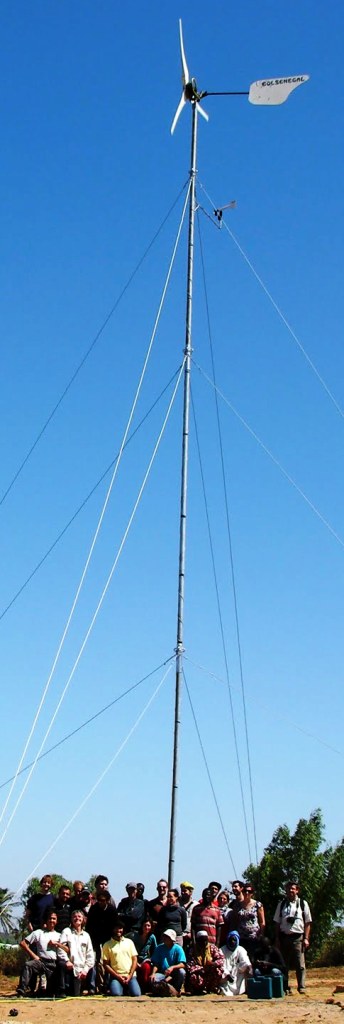
By Pedro Neves - For the first time in history the majority of the organizations working with Piggott-style wind turbines gathered in one place to discuss their experiences and come together to form a global association to further their efforts. The innovative conference on small wind power took place during the 2011 World Social Forum in Dakar, Senegal between the 7th and 11th of February at the Cheik Anta Diop university in Dakar. Not officially part of the WSF, it was organized by CIFRES, EolSenegal and blueEnergy as an opportunity to share techniques and applications of small wind in rural communities. 


Participants view a Piggott-style turbine
The first days of the conference were dedicated to the presentation of the different organizations present. From the groundbreaking experiences of Scoraig Wind to new ventures such as I Love Windpower Mali and Tanzania, commercial experiences of SolarMad, the activism of Tripalium, the integrated support of Renewable World and the holistic experience of blueEnergy, the hardest-working names in small wind had an opportunity to corroborate. The presentation of the organizations was followed by the carving of blades and winding of coils for a small experimental penta-bladed machine. During the first days of the conference two technical discussion sessions - by Noam Dotan from COMET-ME and Pedro Neves from blueEnergy -were also held alongside an exposition by Aurore Valverde and Julie Zarka from blueEnergy on the social aspect of using small wind turbines for rural electrification. The intent of the first was to put all the organizations present sharing the problems they face and the solutions they have found for them. The second intended to share the difficulties of implementing small wind turbines without the proper social intervention.

 
Mbay Mbay
On the fourth day of the conference a visit to the community of Mbay Mbay allowed the participants to see one of the wind turbine systems installed by EolSenegal. Mbay Mbay is a rural community focused on agriculture, relying on diesel water pumps to irrigate the fields. Together with another Senegalese NGO, EolSenegal installed a well pump, irrigation system and associated electrical system. Currently the system is not working as there is a dispute between the ownership of the irrigated fields. Once again the social side reveals itself as a key element in rural electrification.


The presence of several organizations that work with small wind turbines was the perfect base to establish the foundations of a global association of small wind turbine organizations. Upon returning from the visit to Mbay Mbay the ideas and possible objectives of such organization were presented by Mathias Craig from blueEnergy. In the following day these objectives and ideas were further defined - sharing funding leads, sharing technical research and sharing socio-economical models. Workgroups on the practical aspects of the organization, such as the website, name and others were formed and put to work on site. This resulted in the launching of a global association. 

To close the week of conferences a round-table session on rural electrification and development was held. The round table drew upon different experiences and knowledge from different organizations such as Scoraig, Renewable World, Aja Mali, Solar Mad as well as Comet ME. This diversity motivated the expressive participation of local students and business development actors that asked questions and intervened on the topic of hybrid solar-wind rural electrification.