blueEnergy works to create a more equitable, sustainable world

8/09/2011

blueEnergy Experiments with its First Solar Latrine

By Andrew Peterson and Mark Allison -- As the world population approaches eight billion people, basic sanitation and waste management will become an increasingly difficult and important topic. Mismanagement of waste can contaminate potable water sources, spread disease and contribute to diarrhea, the second leading killer in developing countries. To address this issue in the Bluefields community, blueEnergy gave Service Learning (SLI) interns, Mark Allison and Andrew Peterson, the task of implementing  solar latrines into the water and sanitation department of blueEnergy. Overall the goal is that solar latrines will help offer a sustainable and sanitary solution to waste management in Bluefields.

Many latrines in the Bluefields community are basic pits dug into the ground and have the possibility of contaminating gound water sources, affecting the families that use them. This was the case with the family that was selected to be the first beneficiaries for a blueEnergy solar latrine. The family was selected due to their location (solar radiation, a garden, no close ground water source, and available space for construction), their interest in the solar latrine project and the need for a more sanitary waste management system. The latrine that the beneficiaries were using before blueEnergy’s project was a rustic latrine that had one pit for garbage, solid, and liquid waste. The rustic latrine also did not have adequate walls for privacy or ventilation for bugs and smell.
fig 1. Solar Latrine Beneficiaries
fig 2. Rustic Latrine previously used by the Beneficiaries

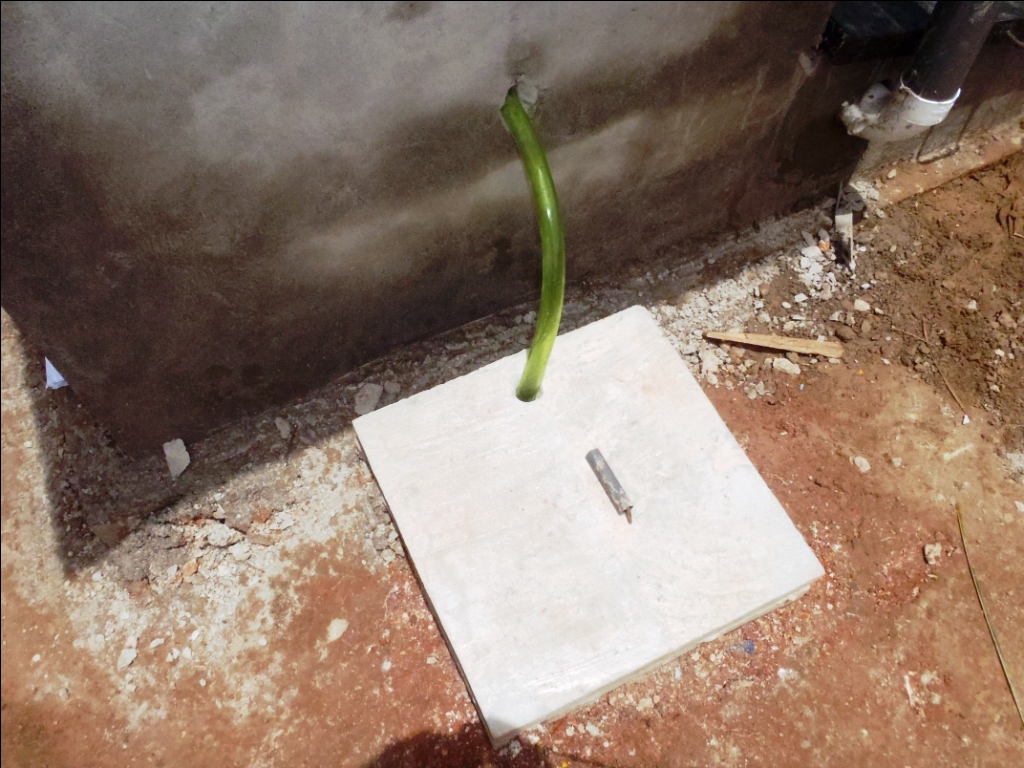
As mentioned before, solar latrines are sustainable and sanitary. Using a solar collection chamber (fig. 3) human waste is cooked and dried, effectively killing any harmful bacteria and leaving rich compost that can be used to improve crop yields. The chamber is divided into three sections into which waste is raked every 15 days. To make sure that the human waste dries completely, the solar latrine has a toilet bowl that contains two different bowls (fig. 4). Solid waste goes into the larger back chamber, while liquid waste goes into the front bowl and then into a separate pit outside the latrine (fig. 5).

fig 3. Solar collection chamber

fig. 4 Toilet seat with divisions
fig. 5 Urine filtration chamber


In the following weeks blueEnergy will be performing follow up evaluations and further education with the beneficiaries. As part of the contract that was signed, blueEnergy will be permitted to make regular visits to the site to take temperature readings of the chamber, evaluate the compost and make sure that the beneficiaries are using the latrine correctly. Depending on the outcome of these visits blueEnergy will be able to determine if solar latrines are successful in Bluefields or if a different type of latrine should be built and tested by future SLI’s.

Mark and Andrew and future latrine builder

8/06/2011

Teaching kids to teach themselves about the environment

By Marcy Ostberg -- For the past four years I have been a teacher in Boston, Massachusetts. During the school year my focus is devoted to the student’s questions and interests. As a result I like to spend my summers traveling and exploring my own personal questions. This year I had the opportunity to spend three weeks as a service learning intern with blueEnergy. I came to Bluefields wanting to learn more about alternative energy, but as I reflect on my time here I realize I have learned far more than originally expected. I have witnessed the resilience of a community up against many challenges and along with the bE staff have grappled with the complexities of finding sustainable solutions to these problems. I have filled many pages of my journal with new ideas and deeper questions. In this Blue News article I will focus on one small snapshot of my experience here, an opportunity I had to see how education can be used as a catalyst to change.
Marcy distributing trash

Unfortunately one of the first things I noticed as a visitor to Bluefields was the trash. The streets and waterways are littered with plastic bottles, water bags, chip bags, and other items such as diapers, cigarettes and beer bottles. I began asking questions looking for the cause. I learned that part of the problem is an ineffective waste management system. There is an open dump on the outskirts of the city yet the trash pickup is inconsistent at best. Although the dump trucks have a schedule it is rarely kept and therefore the residents are unsure when to bring out their trash. It is also difficult to get trash to the trucks, especially for families who live down winding alleyways, deep within the barrios. This ineffective waste management leaves few options and many choose to pile and burn.


One of the first steps to improve this situation is teaching the community to reduce the amount of waste they produce. blueEnergy wanted to capture my experience as a teacher and asked me to develop a lesson plan around this topic. The goal was to help students in Bluefields critically think about this issue and introduce waste reduction as one part of the solution.
Gabriella helping Marcy teach about waste in Bluefields

The lesson was designed around a teaching strategy called experiential education. The basic idea is that students have an experience with the topic, reflect on the experience, learn more about the topic and then apply what they have learned. I wanted to use this strategy to help the students really engage. For the initial experience students made hypothesis about the type of trash that would be most common. They then tested their hypothesis by sorting through trash I had collected from the street and counting the most common items. They found that the small blue bags for drinking water were the most common item, followed closely by chip bags and plastic bottles. Following this experience students brainstormed questions in response to the prompt. They came up with some excellent questions about why this problem exists, how does waste management work in Bluefields and what are possible solutions. I was impressed by their concern for their city. One student said in her reflection, “I love the topic because I learned about how to help my Bluefields.”
Students asking tough questions

Many of their questions were then incorporated into a lesson about how to reduce waste. There final reflections demonstrated that they learned a lot from the lesson. Many of the students made comments about no longer throwing their trash on the streets and had ideas of ways they could improve the situation. One student wisely commented, “It starts from home with your family.” Some students left the lesson really wanting to make a change. One such student said, “We can try something. I promise you when you have a next visit you will see everything change.” We even had some future environmentalists in the group like this student who wrote, “And a word of advice to all. We have to learn that if we continue putting the rubbish in the street it will harm the environment and can cause many diseases such as malaria or dengue. Please do not throw trash on the street and protect our environment.” With comments such as these I felt the lesson was a huge success and left hopeful that the situation would change. I turned back as I left the classroom and saw the school motto painted brightly on a sign. It read “knowledge is power” and after my experience here I would add to that, knowledge is the first step towards change.
Creole-speaking high school, Bluefields, Nicaragua

From Boards to Blades: Challenges working in the developing world

By David Olmos -- The past two months in Bluefields, Nicaragua has given me a fresh perspective on the challenge of implementing renewable energy technology in the developing world. As a Mechanical Engineering student at UC Berkeley, my studies focused on optomizing design for peak efficiency using cutting-edge design techniques. However, in Bluefields the objective was to build a robust and reliable turbine using as much local materials and workmanship as possible.

My first week in the office was spent mostly on the computer, sketching CAD models of what I envisioned the turbine would look like and investigating what would be the optimal airfoil shape for the local wind conditions. In the following week I spent time helping to refurbish “el taller” and getting to know the people at the workshop who were able to demonstrate local blade manufacturing techniques that cannot be found in any coursework or textbooks.

These techniques made it possible to transform 2x4s into fully functioning wind turbine blades. However, this process is not easy. The main challenge faced was figuring out how to make bent pieces of wood into straight turbine blades. It was somewhat of a jigsaw puzzle, choosing where to lay each of the sections of 2x4s that composed each blade in order to avoid weak knots, cracks, or bends. I was impressed by how staff member Gilberto was always able to use what was available in the workshop to overcome such obstacles. A recurring challenge that blueEnergy has faced has been passing on accumulated information from one volunteer to the next. I was glad to help document the techniques and knowledge that I had learned this summer so that it may be compiled into a consoldated manual that will guide future volunteers.
Gilberto, Jorge, Matthieu, Alex, Marcy, David, Pedro and Guthry

By the end of my stay, the three turbine blades were successfully constructed and I have come away with a tremendous amount of knowledge and experience regarding implementing alternative energy solutions in the developing world. With the completion of this 3kW turbine, this installation will have the potential to provide energy for three times the amount of households compared to the current bE turbine system. All in all, it was a summer I will never forget.

7/29/2011

blueEnergy Efficiency Report: Bluefields, Nicaragua

By Jess J. Goddard -- In the energy-lingo of today, “energy efficiency” is a buzzword that permeates policy aiming to reduce costs, lower greenhouse gas emissions, and work toward a better balance between demand and supply side management. So far, most of us are aware of how energy efficiency might benefit a country like the US, where demand is high, the grid complicated, and fossil fuels a source of constant debate.

This article of the blueNews is eager to share the findings of Dan Conner, a recent blueEnergy intern, and his colleague Craig Jacobson from Unity Technical Consulting (UTC). Dan spent two weeks in the field researching what energy efficiency means in a decentralized and low-energy demand setting like Bluefields, Nicaragua. Upon completion of his internship, Dan worked closely with Craig to analyze the data and produce a comprehensive report, “Keys to Energy Efficiency,” on the state of blueEnergy’s energy usage in Bluefields.

The report focuses on “climate-specific energy audit techniques” to recommend energy and cost saving strategies that foster conservation efforts. Their investigation of five blueEnergy properties provides blueEnergy with an up-to-date analysis of the company’s energy consumption, equipment, costs and pricing structures. blueEnergy would like to thank Dan Conner and Craig Jacobson of Unity Technical Consulting for their contribution to blueEnergy’s energy strategy moving forward. Please see the full report here.

7/24/2011

Alumni Spotlight: Mike Dow

By Jess Goddard -- blueEnergy is constantly looking to continue its relationships with intern and volunteer alumni, and this alumni spotlight feature looks at what one intern has done since working abroad withblueEnergy. Mike Dow interned with blueEnergy for five weeks between May and June of 2010, updating and expanding the Maintenance and Operation Manual for training new wind turbine workshop employees in Bluefields, Nicaragua. Mike also aided the technical teamtohelp assemble the first 14 foot turbine prototype – from balancing the blades to hoisting the turbine up and watching the wind turn the blades for the first time – “a very rewarding and memorable moment.”
Mike Dow with the 14' diameter turbine

Mike’s passion for renewable energy and emerging enterprise continues to define his day-to-day life as an MBA student at the University of Colorado at Boulder. The opportunity to apply classroom knowledge to a unique real-world setting and gain exposure to blueEnergy’s community development model provided Mike with an interdisciplinary experience that prepared him for industry in the US.

Such an influence has affected Mike’s choices in pursuing his MBA in Boulder; he writes: “There is a great amount of renewable energy action going on here, from businesses to nonprofits, government laboratories to academia.” He is currently working with a local PV solar installation company and aspires to engage in local energy politics. We look forward to keeping in touch with Mike and encourage our current and past interns to do the same—he made sure to let us know: “My door is always open to bE alums!” blueEnergy wishes Mike Dow the best of luck in 2011!

7/14/2011

Evolutions in our impact model (Part 3 of 4)

By Mathias Craig -- blueEnergy found itself in 2009 facing internal and external pressures to significantly grow its impact. As discussed in Part 1 of this series, blueEnergy’s community development approach on the Caribbean Coast of Nicaragua specifically targets severely marginalized communities that are beyond the edge of the market. There is no one silver bullet to help these communities alter their fundamental situation – a holistic approach is needed to create basic opportunities that can be leveraged by community members to better their own situation. But employing this type of approach beyond the edge of the market is relatively resource intensive on a “per person served” basis, complex and slow...read more

En espanol y Frances...

6/01/2011

RENOVABLES meets in Bluefields

By Lal Marandin -- On May 18th and 19th 2011, blueEnergy helped organize the Regional Conference (RAAS) of the National Campaign to improve the skills of Primary School teachers on "Energy Effiency and Renewable Energy" in Nicaragua.
Participants gathered around to listen

This major event was co-hosted by the Renovables Alliance (www.renovables.org.ni), the Ministry of Energy (MEM) and the Ministry of Education.

Over 100 participants, including 80 primary school teachers met during the two days in Bluefields, where they received general training on Energy, Energy Efficiency and the principles of Renewable Energy. On the second day, quite ironically, Bluefields suffered a major power outage, allowing blueEnergy to demonstrate very clearly the benefits of local and renewable sources, as eight Trojan Batterias and a 4kW Xantrex Inverter powered the computer, projector and many fans, allowed the activity to be completed in optimal conditions.

(left to right): Kenia Joiner (bE), Ing. Coralia Robbleto (MEM), Abdelia Aleman (Renovables), Lâl Marandin (Renovables y blueEnergy), Ing. Lucett Martinez (MEM, y Guillaume Craig (bE)