blueEnergy works to create a more equitable, sustainable world
Showing posts with label Wind Empowerment. Show all posts

9/17/2012

WindEmpowerment at Rio+20

By Mathias Craig (with contributions from Piet Chevalier and Gaël Cesa) -- Piet Chevalier (i-love-windpower Mali and Siemens wind power), Gaël Cesa (Tripalium) and Mathias Craig (blueEnergy) attended the Rio+20 UN Sustainable Development Conference in Rio de Janero, Brazil, from June 16-20 on behalf of WindEmpowerment. We were invited by Siemens AG and Siemens Stiftung to participate in their "Technology in Action" display initiative at the Conference. The opportunity materialized because WindEmpowerment's Technical Director, Piet Chevalier, is an employee in the Siemens wind power division, working as an engineer on off-shore wind turbine design and because of his work in Mali and with WindEmpowerment, he was able to convince Siemens to support WindEmpowerment's attendance.


The purpose of the visit was four-fold:

1) to display WindEmpowerment in the Siemens/UNEP tent to promote the association,
2) to identify potential funding sources for WindEmpowerment,
3) to teach a hands on wind turbine building workshop, and
4) to work with a local NGO to install a wind turbine in the Rio de Janeiro area.

Prior to the conference Piet built two Siemens-funded wind turbines in Holland and shipped them to Rio. These two turbines were used for display at the conference, one going outside the UNEP tent and one inside near the speaker’s podium.


Piet and Gaël arrived in Rio on June 2nd to connect with local organizations about the wind turbine workshop and installation, to prepare the display installations and to acquire the materials, tools and space needed for the workshop.
           
There were many challenges in preparing the display installations, in particular for the outdoor one, including concerns about safety, the construction of a tower and more. But Piet and Gaël persevered and were ultimately successful in getting two very high profile, attractive displays put together.

The displays attracted the attention of high-ranking members of Siemens, including the CEO of the Renewable Energy Hydro and Solar division, the CEO of Siemens Brazil (shown below), and a very high ranking member of the managing board. It also drew the attention of visiting dignitaries, institutional representatives and academics.


Throughout the key four days of the conference, Mathias had multiple opportunities to speak from the podium in the UNEP tent and explain WindEmpowerment. This helped the association gain broader exposure to an interested audience.

During the conference, we learned of a competition being held by Siemens Stiftung called “empowering people. Award”. The award is intended to support organizations and individuals whose innovations are contributing to development and bettering lives around the world. We are exploring the possibility of applying for the award, which could be an opportunity for WindEmpowerment to gain broader exposure.

Prior to the main conference and in parallel to it, Gaël and Piet organized a complete wind turbine building workshop. There were 8 participants in the workshop: 6 university students from the University Federal Rio de Janeiro (UFRJ), one member of a social organization and one engineer.

Gaël led the workshop and over a period of 8 days the students completed a 2.4m, 48V Piggott wind turbine from scratch.


The students were part of a group at their university that promotes agroforestry and composting in Rio and the surrounding areas and this wind turbine workshop was a nice hands-on addition to their experience.

In addition to this complete workshop, a series of mini-workshops were given at the start of the conference on blade carving and on the theory and design of the turbine. These sessions at the UNEP tent were attended by 30 students, many of who were interested in staying involved beyond the conference.

At the conclusion of the conference, Piet and Gaël worked to install the wind turbine produced in the Rio workshop and put it into operation. The turbine was installed on private property in the town of Araruama, about 1.5 hours north of Rio. The advantage of the site is that many low-income farmers have access to the site and there is potential to link the system to an abandoned school that could be transformed into a wind turbine training center.

The installed system is comprised of: 2.4m Piggott wind turbine, 40ft tilt-up tower, MorningStar 45 charge controller, Phoenix 750W 48V DC 220 VAC inverter, 4x 12V 160AH battery bank (in series).

The tools purchased for the workshop are stored on this site for future use in wind turbine building activities. With all the interest generated at the conference and the workshop we are optimistic that this initiative is just the beginning of an emergence of small-scale wind power in Brazil.

A picture album of the activities can be viewed here. A video of the wind turbine workshop can be viewed here.

For more information about WindEmpowerment’s presence at the Rio+20 event, please contact Piet Chevalier @ piet@i-love-windpower.com

3/05/2011

Piggott-style wind turbine conference in Dakar, Senegal

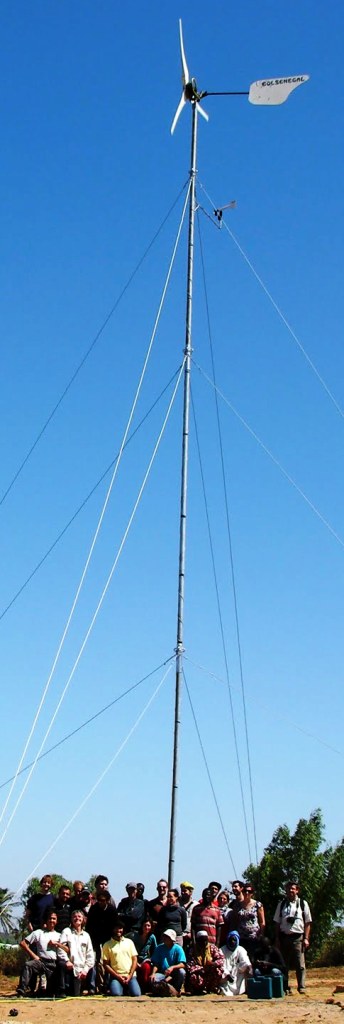
Participants of the wind-power conference in Dakar, Senegal
By Pedro Neves - For the first time in history the majority of the organizations working with Piggott-style wind turbines gathered in one place to discuss their experiences and come together to form a global association to further their efforts. The innovative conference on small wind power took place during the 2011 World Social Forum in Dakar, Senegal between the 7th and 11th of February at the Cheik Anta Diop university in Dakar. Not officially part of the WSF, it was organized by CIFRES, EolSenegal and blueEnergy as an opportunity to share techniques and applications of small wind in rural communities. 


Participants view a Piggott-style turbine
The first days of the conference were dedicated to the presentation of the different organizations present. From the groundbreaking experiences of Scoraig Wind to new ventures such as I Love Windpower Mali and Tanzania, commercial experiences of SolarMad, the activism of Tripalium, the integrated support of Renewable World and the holistic experience of blueEnergy, the hardest-working names in small wind had an opportunity to corroborate. The presentation of the organizations was followed by the carving of blades and winding of coils for a small experimental penta-bladed machine. During the first days of the conference two technical discussion sessions - by Noam Dotan from COMET-ME and Pedro Neves from blueEnergy -were also held alongside an exposition by Aurore Valverde and Julie Zarka from blueEnergy on the social aspect of using small wind turbines for rural electrification. The intent of the first was to put all the organizations present sharing the problems they face and the solutions they have found for them. The second intended to share the difficulties of implementing small wind turbines without the proper social intervention.

 
Mbay Mbay
On the fourth day of the conference a visit to the community of Mbay Mbay allowed the participants to see one of the wind turbine systems installed by EolSenegal. Mbay Mbay is a rural community focused on agriculture, relying on diesel water pumps to irrigate the fields. Together with another Senegalese NGO, EolSenegal installed a well pump, irrigation system and associated electrical system. Currently the system is not working as there is a dispute between the ownership of the irrigated fields. Once again the social side reveals itself as a key element in rural electrification.


The presence of several organizations that work with small wind turbines was the perfect base to establish the foundations of a global association of small wind turbine organizations. Upon returning from the visit to Mbay Mbay the ideas and possible objectives of such organization were presented by Mathias Craig from blueEnergy. In the following day these objectives and ideas were further defined - sharing funding leads, sharing technical research and sharing socio-economical models. Workgroups on the practical aspects of the organization, such as the website, name and others were formed and put to work on site. This resulted in the launching of a global association. 

To close the week of conferences a round-table session on rural electrification and development was held. The round table drew upon different experiences and knowledge from different organizations such as Scoraig, Renewable World, Aja Mali, Solar Mad as well as Comet ME. This diversity motivated the expressive participation of local students and business development actors that asked questions and intervened on the topic of hybrid solar-wind rural electrification.