blueEnergy works to create a more equitable, sustainable world
Showing posts with label RENOVABLES. Show all posts

5/21/2012

blueEnergy Presents at the Global Philanthropy Forum and the World Bank Spring Meeting on Energy Access

By Lâl Marandin -- blueEnergy was fortunate to be invited to Washington DC in April to participate in the Global Philanthropy Forum and the World Bank’s Spring meeting on energy access. While participating in these events, Mathias and I took the opportunity to meet with many constituents – and it ended up being one of our most productive networking opportunities ever.

Global Philanthropy Forum (GPF)

The forum took place April 16 - 18, 2012 at the Fairmont Hotel, under the heading “Toward a New Social Contract”.

“What brings us together this year is the sense that the social contract is fraying, but that it is also evolving,” began GPF’s President and CEO, Jane Wales. “The conference focus is on the changing nature of the global social contract – how globalization is changing the way our societies choose to divide up responsibility and allocate resources to improve the public good. GPF members are exploring the ways in which traditional roles and responsibilities have shifted over the past few years, and how they continue to shift – particularly the increasing power of the individual in the national and global arena, and how the private sector and government can and should work together to increase their impact.”

Videos of most of the forum are available here.

Many notables were in attendance: the Head of USAID, the President and Director of World Bank, the Head of IADB, the Head of IFC, the Director of UNICEF, ex-Premier Tony Blair, US Ambassador for Global Partnerships, UN Head of Climate Change, Cindy McCain and Barbara Bush.

In his keynote speech, Tony Blair insisted on the need for developing countries to invest massively in infrastructure and energy. Those comments that Mr. Blair intended for Africa (where he now works with the AGI Foundation) resonated strongly for the region where blueEnergy strives to help bring sustainable energy for all.

Ex-Premier Tony Blair during his keynote speech at GPF 2012

On a similar note, the Director of the Ford Foundation, Mr. Luis Ubiñas insisted that measuring results was key to the non-profit sector but recognized that many results (such as advocacy) are hard to measure. "That should not detain us," said Mr. Ubiñas, "from trying to work in complex environments and engage in activities which results cannot be measured by “hard” (numerical) indicators."

Much of the attention of the conference was on "impact investing", the concept of doing philanthropy like venture capital investments, often with an emphasis on a blended financial and social return. Both Mathias and I stressed that while this is the new hot topic, it is important to keep in mind that philanthropy needs to continue to play a key role in serving the most isolated poor.

Mathias and I were proud to be able to present blueEnergy’s work on the ground in Nicaragua, in the context of the vast majority of US international philanthropy shifting towards a few countries in Africa and Haiti. The Southern Atlantic Autonomous Region (RAAS) of Nicaragua, where we operate, is the poorest region in the second poorest country in the Western Hemisphere, but often doesn’t get the attention of the development community.

“Co-Designing for Impact” Panel

Mathias insisted in his panel at the GPF on the need to "co-design" solutions for energy or clean water access to ensure their validity and sustainability in a world where there are no "one size fits all" solutions. He stressed how bE works with stakeholders to ensure that our results are long-lasting, and insisted on the importance of funding "collaboration work". This kind of work often requires a different skill set than normal program work and organizations must build and get funding for this.

Video of the panel is available here.

Photo (left to right): Moderator Katherine Rosqueta,
Executive Director, Center for High Impact Philanthropy, UPENN;
Mathias Craig, blueEnerg;  Kate Gross,
Tony Blair Africa Governance Initiative;
Dominic Murren, HumbleFactory

World Bank Spring Meetings : blueEnergy’s Panel, “Business Models for Energy Access”.

Thanks to HIVOS, blueEnergy was invited to join the World Bank spring meetings on April the 18th, alongside social enterprise SELCO from India, Offset4poor and Arc Finance (US), entitled “Business Models for Financing Access to Sustainable Energy in Developing Countries”, moderated by the World Resource Institute and hosted at the World Bank.
On this panel, Lâl Marandin defended the idea that in places of great isolation and vulnerability such as the RAAS in Nicaragua where blueEnergy works, philanthropy must continue to support the development of the adequate business and service ecosystems for other leveraging mechanisms to pick it up from there: micro finance, use of technology (such as cellphone apps, etc..), social entreprise. Lâl explained that blueEnergy believes in the need to "co-design" solutions for energy or clean water access to ensure their validity and sustainability, being focused on a very specific reality (Atlantic coast) where we will continue to promote small solar systems, ecostoves and rustic clean water systems with business models where "sustainability" means investing in social impact first, not hoping for economical returns in the short or medium terms. blueEnergy will continue to explore evolutions of these models and learning opportunities with our partners from the Renovables association.

After the panel, in a quite serendipitous way we were invited to join the happy hour at the Bank Information Center, the NGO watchdog of the World Bank, and were able to meet with Christian Donaldson (BIC) and Sunita Dubey (Basic South initative).

Meeting with Ambassador Francisco Campbell - Ambassador of Nicaragua to the United States

On April 18th we met with Ambassador Campbell in the beautiful Nicaraguan embassy, on the East side of the building, in the "Caribbean Room". In our discussion, Mr. Campbell requested news about Miss Colette and the work with the Ramas. We gave him an update on blueEnergy and the work we’re doing with the Renovables association. We also explained our work with Corn Island mayor (Cleveland Webster) and how we’ve supported his participation at the World Water Forum, in France last March, in coordination with the French Embassy in Managua.
(left to right) Lal Marandin, Ambassador Campbell,
Mathias Craig

María Margarita Espinosa from PRONicaragua participated in the meeting. PRONicaragua was recently honored by the World Bank as the best investing promotion agency in the Americas, and they are a proud member of Renovables.

Throughout the four days in Washington DC we met with partners, funders, government officials and other stakeholders. We are extremely appreciative to all those who made the time to speak with us.

11/28/2011

Renovables Coordinates Carbon Credit Deal for Nicaragua

What is Renovables ?

By Lâl Marandin  -- Founded in June of 2010, the Nicaraguan Association for Renewable Energy and the Environment, known as Renovables is a nonprofit organization whose mission is "to organize and strengthen Nicaraguan actors to expand a fair and efficient use of renewable energy in both the public and private sectors in Nicaragua”. Renovables’ vision is to create impact through projects, national and international partnerships, the development of public policy, dissemination of good practices, scientific research, public awareness and formal education for a sustainable energy future. 

The ultimate goal of its 2015 Strategic plan is to promote the access, production, sustainability and of renewable energy in Nicaragua. Renovables proposes the following objectives in the short and medium term:

• Strengthen the working sector in renewable energy at the national level

• Position the organization at the national and international level

• Promote changes in Nicaraguan law and regulations to better incentivize renewable energy for domestic and corporate uses

• Create a project portfolio to involve all member organizations.

As of the fall of 2011, Renovables is comprised of more than 30 institutions that promote, support or implement clean energy project in Nicaragua, utilizing all possible sources of renewable energy: hydro, wind, solar, geothermal and biomass.

The association aims to contribute, in collaboration with the public and private sectors, to maximize the use of the country's renewable energy potential and to increase renewable energy’s contribution to the energy portolio, in alignment with the National Administration’s “National Energy Strategy”.

Renovables and carbon credits

In this context, the Renovables association began a process in 2011 of identifying alternatives to carbon markets where Nicaragua is eligible so that local developers of renewable energy could take advantage of opportunities for additional income through the sale of Certified Emission Reductions (CER), that are issued on regulated or voluntary markets aiming at mitigating greenhouse gas emissions or sequestering carbon dioxide from the atmosphere. The mechanism has two main components: the creation of the credit through a certification program and the sale of the credit to a buyer on a credit market.

Renovables had been approached since its creation in 2010 by several actors of the carbon credit markets (Southpole, GIZ, HIVOS) but no deal was in sight.

The catalyzing role of blueEnergy

blueEnergy joined forces with two other Nicaraguan NGOs in 2009 to foster the creation and launch of Renovables, and was instrumental in its early growth. Being recognized for that action, blueEnergy was voted Secretary of the Board of Renovables at its inaugural assembly, an event that brought together more than 100 key people of the Renewable energy sector and over 50 institutions in June 2010. Taking this responsibility very seriously, blueEnergy appointed Lâl Marandin (blueEnergy co-founder and Managua Office Director) to support the growth of the young and promising association, and provide any needed support.

Forming a dynamic team with Renovables appointed Executive Director, Lizeth Zúniga (former country director of BUN-CA in Nicaragua), Lâl identified and negotiated a quick-win opportunity to utilize the Kyoto Protocol market through one specific clean development mechanism (CDM): the Program of Activities (PoA) Guacamaya, which was designed for small-scale hydroelectric projects.

This PoA is one of the two existing PoAs that have been developed for Nicaragua. The PoA structure is relatively new in the Kyoto Protocol proceedings, and is designed to group projects that use either several clean technologies in one given country, or the same technology in several countries. This new CDM structure was developed to allow smaller scale actors to take advantage of the complex Kyoto Protocol Market, through the sharing of registration and monitoring costs between the energy projects that join the Program.

How could Nicaragua take advantage of this opportunity? blueEnergy made this idea a reality in two ways:

1) by having established throughout the years a very complete database of actors and contacts, blueEnergy helped track down many current and potential project developers in the hydro sector, so that they could be presented with the program and decide to join.

2) by coordinating with several actors, and with the financial support of the ECNER project funded by the Common Fund for Governance in Nicaragua, blueEnergy made possible the organization of a workshop on “Carbon Credits for Nicaragua” under the leadership of Renovables and EcoRessources in Managua on August 3rd, 2011.

The event clearly highlighted for the public the general gaps and opportunities on the CER topic in Nicaragua, and created the conditions to present and explain the PoA Guacamaya’s specific requirements and benefits. It also helped identify other options for other types of power generation, through the Kyoto Protocol market or Carbon voluntary markets. More than 50 key actors were in attendance, including project owners and developers, actors from the Renewable Energy Sector in Nicaragua and government officials.
Left to right: Marlyng Buitrago, President of Renovables. Patricia Rosenthal, representative of
MABANAFT, Gianluca Merlo, EcoRessources; Christian Giles, Anaconda Carbon
This specific opportunity is seen by blueEnergy and Renovables as a first step towards the utilization of the largest quantity possible of CERs in Nicaragua, and blueEnergy is currently supporting Renovables in identifying other opportunities for other technologies.

Renovables’s strategic agreement with EcoRessources

As part of its contribution to the development of clean energy in Nicaragua, with the aim of exploring opportunities to enter the regulated carbon market under the Kyoto Protocol, Renovables signed a very important framework partnership agreement in July 2011 with the owners of the PoA, to allow Nicaragua to join the program. By doing so, it automatically allowed Nicaragua to benefit from the Kyoto mechanism for certification of emissions credits for the small-scale hydro sector for the next 28 years, when this door was closing for good: the Kyoto Protocol will indeed be terminated in December of 2012, with no clear vision of what comes next.

Also importantly, the agreement signed by Renovables with EcoRessources and the owners of the PoA includes a percentage of any CER transaction made for Nicaragua to be donated back to Renovables, supporting the financial sustainability of the Association.

More information of the Guacamaya PoA :

The Guacamaya PoA was originally developed for Honduras, Costa Rica, and Guatemenla by Anaconda Carbon (a firm based in Honduras that works with companies and organizations to achieve their corporate social responsibility and sustainability goals and acts as the coordinating body for the program); Mabanaft (a private group of German origin founded in 1947 who is the buyer of credits) and EcoRessources, a Canadian company with representation in Nicaragua, developing offset projects and carbon credit management for emerging markets of voluntary compliance.

The ultimate goal of this agreement is to foster the identification and promotion of hydroelectric projects under 15 MW in Nicaragua.

The eligibility criteria for the Guacamaya PoA are:

• Small-scale hydroelectric projects (less than 15 MW, can also be applied to new repowering projects total power less than 15 MW)

• Must operate run-of-the-river with no more than a daily control reservoir, if any

• Must comply with laws and regulations of Nicaragua

• Must have a Power Purchase Agreement with the national network (PPA Power Purchase Agreement)

The strategic importance of opening the Guacamaya PoA to Nicaragua lies in the possibility of selling credits into the European carbon market after the end of 2012, when the Kyoto Market will close. The European market is guaranteed to exist for the next 10 years.

This program will allow small-scale projects generating carbon credits to access the carbon market with zero upfront costs by the project owners. It also offers an attractive purchase agreement (ERPA) with Mabanaft (cash flow guaranteed and an opportunity to benefit if the carbon market is on the rise), simplified compliance process, and the possibility of exchanging information with similar actors in Central America.

Anaconda Carbon and Mabanaft are currently in talks with financial institutions to use the ERPA as collateral for bank loans. All parties involved have strength, experience, local presence and financial backing.

It is important to note that the Guacamaya PoA has a validity of 28 years for the certification of CER credits. So any project may now register itself over the next 28 years, at the time it is launched, and produce CER credits that it can then sell on voluntary markets and on the European market for carbon credits, which will be active for at least the next 10 years.

10/24/2011

Renovables Gets Formal Status

By Lâl Marandin -- Founded in June of 2010, the Nicaraguan Association for Renewable Energy and the Environment, known as “Renovables” is a nonprofit organization whose mission is "to organize and strengthen Nicaraguan actors to expand a fair and efficient use of renewable energy in both the public and private sectors in Nicaragua”. “Renovables” ’ vision is to create impact through projects, national and international partnerships, the development of public policy, dissemination of good practices, scientific research, public awareness and formal education for a sustainable energy future. "

The ultimate goal of its 2015 Strategic plan is to promote the access, production, sustainability and of renewable energy in Nicaragua. “Renovables” proposes the following objectives in the short and medium term:

• Strengthen the working sector in renewable energy at the national level

• Position the organization at the national and international level

• Promote changes in Nicaraguan law and regulations to better incentivize renewable energy for domestic and corporate uses

• Create a project portfolio to involve all member organizations.

As of the fall of 2011, “Renovables” is comprised of more than 30 institutions that promote, support or implement clean energy project in Nicaragua, utilizing all possible sources of renewable energy: hydro, wind, solar, geothermal and biomass.

The Association aims to contribute, in collaboration with the public and private sectors, to maximize the use of the country's renewable energy potential, and to increase renewable energy’s contribution to the energy portolio, in alignment with the National Administration’s “National Energy Strategy”.
The founders of "Renovables", June 17th, 2010

What the “Personería Jurídica” is and why it’s a big deal

Obtaining “Personería Jurídica” means filing and being awarded a legal status as a nonprofit in Nicaragua. It requires a majority vote by the National Assembly (Congress) and is a process that can take up to five years.

Three major factors made it very important for “Renovables” to obtain it as quickly as possible, but also made it complicated:

1) Nonprofits in Nicaragua have been under very strict surveillance since the start of the new Ortega Administration in January 2007. There has been increased controls and audits of many nonprofits, especially those receiving funding from international or multilateral aid agencies.

2) Adding to the tension, the energy sector is absolutely strategic for Nicaragua, a country that doesn’t currently own fossil fuels reserves and has the most expensive electricity in Central America. The government and its Ministry of Energy and Mines play a central role, and debates on energy prices and strategy are constant in the media.

3) Large private energy groups have gained a very strong importance in the country. Some of them had a tendency to shift the legal and political weight towards their specific interests. It was key to counter balance their influence and overcome any possible hindrance they could have created, preventing “Renovables” from obtaining the Personería Jurídica.

For these reasons, and many more, it was of paramount importance that “Renovables” be able to legalize its legal status in the country, giving it the ability to speak with a strong a clear voice for the sector it represents.

The catalyzing role of blueEnergy

blueEnergy joined forces with two other Nicaraguan NGOs in 2009 to foster the creation and launch of “Renovables”, and was instrumental in its early growth. Being recognized for that action, blueEnergy was voted Secretary of the Board of “Renovables” at its inaugural assembly, an event that brought together more than 100 key people of the Renewable energy sector and over 50 institutions in June 2010. Taking this responsibility very seriously, blueEnergy appointed Lâl Marandin (blueEnergy co-founder and Managua Office Director) to support the growth of the young and promising association, and provide any needed support.

With the financial support of the “ECNER” project, awarded in March 2010 to blueEnergy (and its partners ATDER-BL and AsoFenix) by the Common Fund for Democratic Governance in Nicaragua, blueEnergy assembled a legal team to achieve the legal status of Personería Jurídica for Renovables.

Since the launch of Renovables in June 2010, Lâl has worked to motivate and coordinate the association’s staff in order to advance the process. This has required constant problem solving and clear decision making to make sure the process did not get derailed. blueEnergy wishes to thank Roberto Sosa, Marlyng Buitrago and Lizeth Zúniga for their support to Lâl and their key role in making this happen for “Renovables”.   

“Renovables” is now an official Nicaraguan Nonprofit!

On September 2nd, 2011, the National Assembly of Nicaragua awarded the Personería Jurídica to “Renovables”. This success happened 12 months exactly after the original filing of the paperwork, which is a very impressive performance given the challenges encountered along the way.

As an example of the challenges, it was ruled at some point in the process by a legal counselor of the National Assembly that private institutions cannot be founders of a non-profit organization. This statement has no legal base in the current nonprofit law #147. The Supreme Council of the Private Enterprise (COSEP), representing the private sector in Nicaragua since 1972, offered its support to “Renovables” to counter the argument, with legal action if necessary. Fortunately “Renovables” was able to resolve the conflict outside of legal action.

“Renovables” will now have to comply with all the required nonprofit regulations in Nicaragua, which is all it has ever hoped for!
Copy of the statement of Personería Jurídica,
awarded by the National Assembly of Nicaragua,
September 2nd 2011

6/01/2011

RENOVABLES meets in Bluefields

By Lal Marandin -- On May 18th and 19th 2011, blueEnergy helped organize the Regional Conference (RAAS) of the National Campaign to improve the skills of Primary School teachers on "Energy Effiency and Renewable Energy" in Nicaragua.
Participants gathered around to listen

This major event was co-hosted by the Renovables Alliance (www.renovables.org.ni), the Ministry of Energy (MEM) and the Ministry of Education.

Over 100 participants, including 80 primary school teachers met during the two days in Bluefields, where they received general training on Energy, Energy Efficiency and the principles of Renewable Energy. On the second day, quite ironically, Bluefields suffered a major power outage, allowing blueEnergy to demonstrate very clearly the benefits of local and renewable sources, as eight Trojan Batterias and a 4kW Xantrex Inverter powered the computer, projector and many fans, allowed the activity to be completed in optimal conditions.

(left to right): Kenia Joiner (bE), Ing. Coralia Robbleto (MEM), Abdelia Aleman (Renovables), Lâl Marandin (Renovables y blueEnergy), Ing. Lucett Martinez (MEM, y Guillaume Craig (bE)

3/05/2011

Piggott-style wind turbine conference in Dakar, Senegal

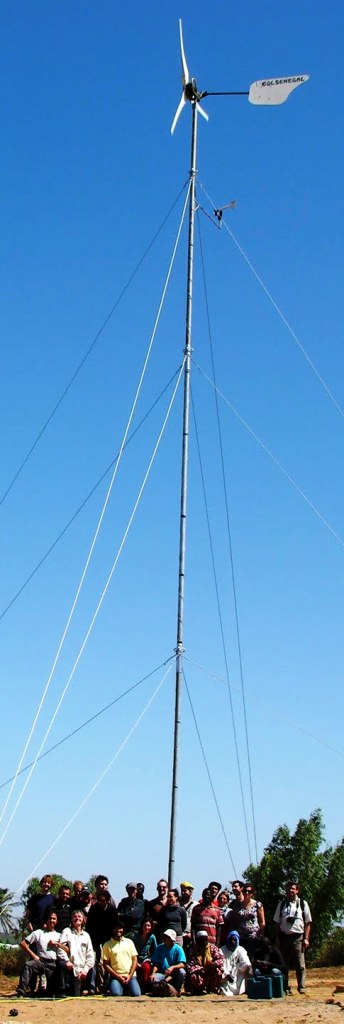
Participants of the wind-power conference in Dakar, Senegal
By Pedro Neves - For the first time in history the majority of the organizations working with Piggott-style wind turbines gathered in one place to discuss their experiences and come together to form a global association to further their efforts. The innovative conference on small wind power took place during the 2011 World Social Forum in Dakar, Senegal between the 7th and 11th of February at the Cheik Anta Diop university in Dakar. Not officially part of the WSF, it was organized by CIFRES, EolSenegal and blueEnergy as an opportunity to share techniques and applications of small wind in rural communities. 


Participants view a Piggott-style turbine
The first days of the conference were dedicated to the presentation of the different organizations present. From the groundbreaking experiences of Scoraig Wind to new ventures such as I Love Windpower Mali and Tanzania, commercial experiences of SolarMad, the activism of Tripalium, the integrated support of Renewable World and the holistic experience of blueEnergy, the hardest-working names in small wind had an opportunity to corroborate. The presentation of the organizations was followed by the carving of blades and winding of coils for a small experimental penta-bladed machine. During the first days of the conference two technical discussion sessions - by Noam Dotan from COMET-ME and Pedro Neves from blueEnergy -were also held alongside an exposition by Aurore Valverde and Julie Zarka from blueEnergy on the social aspect of using small wind turbines for rural electrification. The intent of the first was to put all the organizations present sharing the problems they face and the solutions they have found for them. The second intended to share the difficulties of implementing small wind turbines without the proper social intervention.

 
Mbay Mbay
On the fourth day of the conference a visit to the community of Mbay Mbay allowed the participants to see one of the wind turbine systems installed by EolSenegal. Mbay Mbay is a rural community focused on agriculture, relying on diesel water pumps to irrigate the fields. Together with another Senegalese NGO, EolSenegal installed a well pump, irrigation system and associated electrical system. Currently the system is not working as there is a dispute between the ownership of the irrigated fields. Once again the social side reveals itself as a key element in rural electrification.


The presence of several organizations that work with small wind turbines was the perfect base to establish the foundations of a global association of small wind turbine organizations. Upon returning from the visit to Mbay Mbay the ideas and possible objectives of such organization were presented by Mathias Craig from blueEnergy. In the following day these objectives and ideas were further defined - sharing funding leads, sharing technical research and sharing socio-economical models. Workgroups on the practical aspects of the organization, such as the website, name and others were formed and put to work on site. This resulted in the launching of a global association. 

To close the week of conferences a round-table session on rural electrification and development was held. The round table drew upon different experiences and knowledge from different organizations such as Scoraig, Renewable World, Aja Mali, Solar Mad as well as Comet ME. This diversity motivated the expressive participation of local students and business development actors that asked questions and intervened on the topic of hybrid solar-wind rural electrification.

12/10/2010

Nicaraguan renewable energy alliance RENOVABLES makes strides


RENOVABLES alliance pushing for change
RENOVABLES working hard on policy change
By Lal Marandin -- The RENOVABLES alliance and the Ministry of Energy and Mines set up two ad-hoc work groups to address improvements that the Alliance requires be made national legal norms on Renewable Energy production and distribution in Nicaragua. The first ad-hoc work group addressed the unfair legal status of small hydro producers and concessions. The second was a think tank on how to implement feed-in tariffs for renewable energy and focused on a pilot experiment for net metering. 

The work session involved representatives of the relevant expertise within RENOVABLES and Representatives of the Ministry at the Department Director level.  

blueEnergy has been key in the RENOVABLES alliance's creation and growth, with bE Managua Director, Lal Marandin, serving as Secretary. 

Minister of Energy and Mines, Ing. Emilio Rappaccioli welcomes RENOVABLES and pledges his support to work in partnership.
From left: E. Rappaccioli, Marlyng Buitrago (of Prolena, President of RENOVABLES), Lâl Marnadin (of blueEnergy, Secretary of RENOVABLES), Jaime Munoz (of AsoFénix, Vice-President), Ing. Donald Espinosa (Secretary general of the Ministry of Energy) and Roberto Sosa (Board Member of RENOVABLES).


RENOVABLES alliance welcomes its first Executive Driector
By Lal Marandin -- On November 22nd the RENOVABLES alliance hired Ms. Dinora Sandino, its first ever Executive Director who was selected amongst 170 candidates. 

Dinora has an extensive experience in the non-profit sector, and has worked the last decade with CARE in Nicaragua on a wide range of development projets.
Welcome Dinora!

RENOVABLES meets with HIDRORED.
RENOVABLES meets with partner HIDRORED
By Lal Marandin -- Rafael Portal Escobar, from Practical Action Peru and member of HIDRORED, visited the offices of RENOVABLES for a very productive work session on November 22nd. The Ministry of Energy and Mines (Mr. Rolando Reyes) also attended. 


11/05/2010

blueEnergy in the news

Read about blueEnergy in the latest issue of Wind Directions online magazine:

http://www.ewea.org/fileadmin/emag/winddirections/2010-09/#/34/

Y si lees Espanol, puedas leer un articulo de blueEnergy por La Prensa Libre:

http://www.laprensa.com.ni/2010/10/03/nacionales/39526

10/01/2010

RENOVABLES welcomes new members

By Lal Marandin -- On August 19th, the RENOVABLES alliance proudly announced that it was joined by the major players of the hydroelectric (Tumarin), the windpower (AMAYO) and the geothermal (POLARIS) sectors. RENOVABLES now has 22 active institutional members belonging to all the renewable energy sectors of the country. blueEnergy has been elected Secretary of the organization, and the presidency was voted to Proleña (on the pictures, Marlyng Buitrago, President of RENOVABLES). The PRONicaragua agency, a non-profit promoting international invesment in Nicaragua, was accepted as the first “honorary member” of the association. 

Forum on the Nicaraguan Energy Legal framework

By Lal Marandin -- On August 19th, the RENOVABLES alliance in partnership with UNDP Nicaragua, the Ministry of Energy and Mines, and BCIE’s ARECA project (www.areca.org) held a historic forum at Hotel Barcelo Managua attended by all the legal experts and major players of the energy sector. The objective of the event was to summarize 10 years of proposed improvements to the national legal dispositions to incentivize renewable energy and allow the private sector, non-profit as well as for profit, to continue and support the changes that are required to continue the growth of renewables in the country. As part of the organizing committee of the event and as co-founder of RENOVABLES, blueEnergy was key in bringing the key players in the same room and creating the conditions for the Ministry to agreed on a series of next steps to address immediately some of the most concerning issues.